Saturday, March 27, 2021

After a year of lock-down

“One of the saddest lessons of history is this: If we’ve been bamboozled long enough, we tend to reject any evidence of the bamboozle. We’re no longer interested in finding out the truth. The bamboozle has captured us. It’s simply too painful to acknowledge, even to ourselves, that we’ve been taken. Once you give a charlatan power over you, you almost never get it back.”

― Carl Sagan, The Demon-Haunted World: Science as a Candle in the Dark

I have a PhD from Cornell University. While I never met Carl Sagan, I went by his picture multiple times a day. All Cornell professors were brilliant, but he stood out because he managed to convey his brilliance to the masses through words. Today I can do no better than to quote Carl.

I've just read the UK imposed a 5000 pounds ban on travel without a valid reason, which could only be work, the death or birth of somebody in the family. The article went on to detail how two families can meet now if their number is under six and so on. They've vaccinated about half of their population, and their numbers look good. They have a plan that they are following on easing restrictions, which seem ridiculous, and are enforced sporatically. If someone would have told me a year ago that people would accept this sort of rules, I would have believed them mad. But it seems that the bamboozing has been going on long enough to not be stopable in the neear future. Yet I so hope I am wrong.

So, will the terror stop? Is so when? No world war has lasted less than four years, and the current political situation (reaction to the virus) has gripped the whole world. We've never openly admitted that wars are a mistake that we kept repeating every now and then. In this war against the virus, Sweden has refused to torment it's people. Brazil has imposed few restrictions, and has seen fewer deaths per million than the US or than many other countries. Their response is, however, severely criticised.

The press has always been the one to create and feed the wars, and it is not failing at what it's best at in our days. I do hope it will be over soon, but will it? It is the year of the vaccine, but will the vaccine suffice to end such bamboozlement. I want my children to go to school in person (teachers have vaccinated already), and I want the freedom to make choices for myself and my family back. My children would like to see their father -- it's been more than three months since we've seen him last and there are still no flights with the UK. My father has not seen his son in a year and a half. I'd like to see my brother, too and so would my parents, in this life, not the next. I was just reading the requirements for a country to be in the blue zone, i.e., safe, and it's to not have any COVID cases for four weeks. When the vaccines are not 100% efficient, and with a virus that mutates, this requirement is ridiculous. It's like saying "there should be no colds for four weeks in a row." Of course, it depends on the number of tests, and on how honest the testing is. But if the testing is honest, it should be an impossible feat.

Tuesday, March 16, 2021

The thief who saved my life

 I wanted to write this story in December -- because it's when the first day of the revolution happened.  The timing saved as a way to procrastinate. I'd always say I would do it next December. When I was healthy, I had so many things to do -- all seemed more important than writing up stories. And when I fell ill, all days merged into one. But now I don't think I will see another December. 

In December 1989, I was 39 years old. I had a car, but mostly walked everywhere. I used to walk fast. I was faster than everyone I ever knew -- at work or at home. This was a source of pride. If I walked I did not have worry where I parked, or if I parked in somebody's spot. Also, gas was difficult to find, and there were restrictions on which days one was allowed to drive. Sometimes it was the even days, other times it was the odd ones. And the car did not always run, and often needed to be repaired. Not knowing exactly how to repair it every single time it broke, made one feel like less of a man, and I liked to do things at which I excelled.

 Until I retired, I did not wear civilian clothes. I was a doctor in the military -- I, eventually, became a colonel, but I was a mayor at the time.  It seemed that people respected me more as a military man. I was also young and handsome, which helped. I remember I slipped on ice and fell in front of a pharmacy once. All the pharmacists came outside to help me -- there were four of them -- all women. I was young and fit. I did not need help in getting up, but they all wanted to have a chance to talk to me or touch me, to check that I was fine.  After I retired, I lost my health and I sometimes fell on the street. The offers to help were mostly inexistent then. I'd call a neighbour and wait for a hour -- sometimes more and sometimes less -- until he'd come to help me get home.

But I digress, on December 16, 1989 I was visiting Eugen and his wife Liliana for dinner. They are cousins of my wife. Those were times when people visited each other, had time to eat together and talk. There was no social media. The TV was available only for a very limited time, and there was only one program. So, people spent time with each other and found time to visit and to help each other. That day Lili and Eugen had cooked a very good dinner. I liked to help in the kitchen, and I also liked to stay and chat afterwards. So, I left after dark. I was not afraid of crossing the city at night. I was dressed in military clothes and people always treated me with admiration and respect. 

 But that day was different. It was the day the revolution started. There were instigators everywhere, who were aggressive, and there were people who were sent to stop them who were also aggressive. Some were in civilian clothes, but some were police officers. The militia had supported Ceausescu almost to the very end and had been enforcing the regime though whatever means necessary: murder and torture were never out of the question. So, the military and the police were to be feared and killed that night if needed/possible.  All were allowed to do what they needed to do to either end or start the revolution -- depending on their orders -- they could kill and torture whoever they choose; no questions asked. It did not mattered that I was unarmed and a doctor or that I was a man who just wanted to get home that night after dinner with family and friends. The snakes on my insignia were not visible at night. It's also easier to mistreat people who are innocent and who mean you no harm, than those who have something to hide.

I understood the situation, but did not want to return to Eugen's where I knew I would have been welcomed. I was never a coward. I wanted to get home that night. My wife had warned me of the potential danger just a few days ago. She heard that the communism regime was falling apart in other countries, and thought Romania would be next. She begged me to take civilian clothes and to be careful: to avoid walking alone, and to avoid unnecessary risks. I did not listen. Communism in Romania seemed too strong to be shaken off. There were spies and agents everywhere who would steal and take whatever they wanted from whomever they wanted. It seemed so convenient for them. I thought it would never end. Also, in spite of this, the country was settled and productive in certain many ways. But my wife is a smart woman. She understands the world and has the common sense to doubt herself and those around her, and to ask questions and see a general trend when it's there.

I'd figure I could walk through the graveyard. I thought it would be safe. I was never afraid of dead people -- only of those who were alive. But as I turned toward the graveyard a man who was stealing a case of champaign screamed "pick the other end up". He looked like he had just broken a window to a nearby store to take it. I was used to obeying orders, and instinctively did as he told me. He took my military cap and put it under his other arm and said "they'll shoot you when they see you with this". They would have, too. We later found out that that particular graveyard had been used as torture ground. They found tortured bodies in crypts. I would have been a walking duck, and perhaps they would have claimed I perpetuated the torture after they murdered me. But it was not to be. A group of protesters passed us by yelling "Jos Ceusescu! Jos Ceausescu!" (Down with Ceausescu), we yelled with them even louder. Next, a group of police officers passed by yelling "Sus Ceausescu! Sus Ceausescu!" (Keep Ceausescu in power). We yelled the same and so on. Eventually, we turned the corner and entered the thief's house. By that time, he also had my coat and I was wearing his cap. The pants were dark, and nobody could tell I was in military clothes. I later walked home dressed in the man's clothes, while he kept my military garments. I stayed with him for some hours. He offered me some champaign bottles, I refused. I was happy to have my life without the champaign, and I did not want the added burden of taking something that was not mine to take. I left when the voices outside quieted down. I still don't know his name, but I've been grateful since to the man who saved my life. 

 After I returned home, I dressed in my wife's clothes when I stepped outside. Luckily she had trousers -- they were white, just a bit too tight and too short. It served me right. I was glad I did not have to wear dresses. When I lost my strength, thieves would steal money and my phone from me. They reminded me, perhaps unjustly, of the man who saved my life, and I was never too bitter of the loss. Of course, that man was not a ordinary thief. He was taking a case of champaign from a store, and chose to save my life when I walked by after I chose to help. He was not harming people.

Today I listen to the radio. I am parlysed and can't move left or right. I can only adjust the button on the radio as I listen to people who steal or destroy lives in the name of COVID-19. People don't understand that the name does not matter. It can be COVID-19, it can be Stallin or Ceausescu. The actions are what brings the impact. I've just heard that the foster care program has been derailed for a year and that the damage continues during the third wave. Children are kept in various institutions instead of being sent to families to stop the spread of COVID. This is crimial. It destroys lives. They steal from the most vulnerable and then have the callousness to say it's for the good of someone else. Old people over 65 are not allowed to go out again -- unless it's within certain hours and for a specified reason. What people over 65 neeed most is excercise. Curtailing that is criminal. Those in care homes cannot receive visits. That they live for those visits it does not matter. Neither does it matter that before those visits are almost the only times when their caretakers are treating them as humans and not as an often unwanted job. I am lucky to be with family, but even so it's hard to have no friends who visit. I have not seen my son in over a year. I may never seen him again -- in this life -- and I am not sure there is a next life. My grandson, Edward, asures me it must be so because of conservation of energy. But, overall, I wish more people would be like the thief who saved my life. I wish people would take the opportunty to save a life when they can independently of what they are doing at the time: to not be so afraid of being good, even while they are being bad.

Friday, February 26, 2021

The virus slows down. Is it the vaccine?

We look at various countries and try to see how the vaccination rate affects the number of cases and the death rate.

First of all, there is a remarkable drop in worldwide infections and deaths. While some rich countries have received enough vaccine doses to make a difference, I don't think there was enough vaccine to justify this global effect.

Just to be clear, I have never said that the vaccine does not work. So far, all hard evidence available to me points to the fact that the vaccine does what it should: it protects people from becoming infected and, if vaccinated people become infected, the infection is less severe. Thus, the vaccine does work.

There is debate if the immunity from the vaccine is better or worse than the immunity acquired from infection. I will not get in that debate, but we should acknowledge, from past experience, that some vaccines give immunity that is worse and some better than from infection itself. Regardless, any immunity is good and will reduce infections and deaths.

About one year ago, in February 2020, I have placed the Coronavirus mortality at 0.2% of the infected population. This is vastly less than the number of people tested positive because most people with mild symptoms won't be tested.

A pandemic stops when most people have been immunized through either infection or vaccination.

In the following, we will take countries one by one, starting from the ones who have vaccinated the most and see if and why the slowdown is due to the vaccine.

Israel

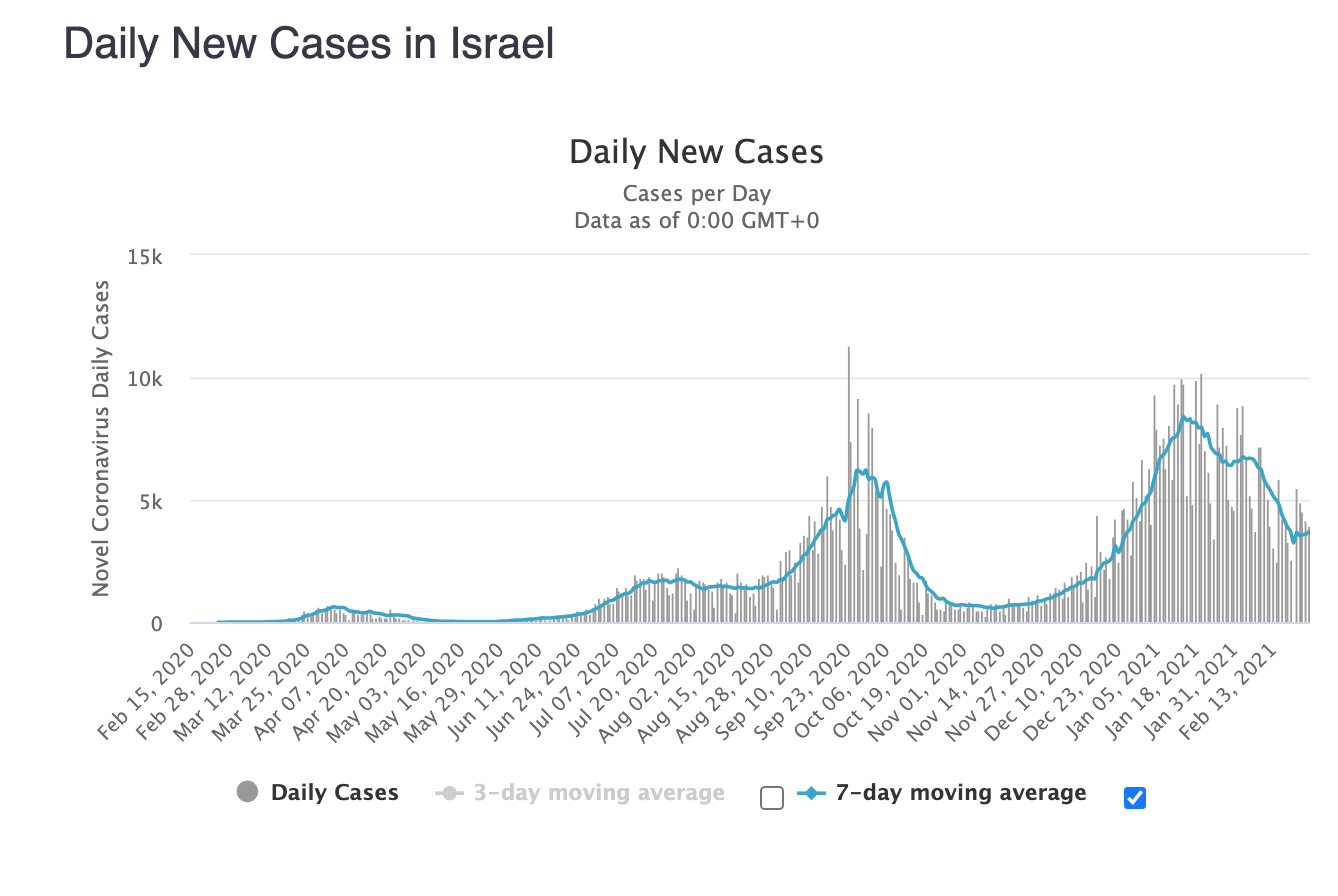
Israel is the world leader in vaccination, with about 90 does given for 100 people. That is somewhere between 45% and 90% vaccinated, depending on the fraction of people who received one of 2 doses. The Israeli policy has been to offer people 2 doses as fast as possible. Thus, the number is close to 50%.

Infection rates are relatively low in Israel, with 618 deaths per million. That is, based on my expected 0.2% mortality, only about 30% of Israelis have been infected.

Given that infection and vaccination are poorly correlated, it's reasonable to assume that 50% of the 70% uninfected people are vaccinated.

This leaves us with 35% of the population susceptible.

Due to this relatively large susceptible population, the reduction in both infections and deaths is nowhere near as spectacular as the vaccine progress.

Sure, once almost the entire population is vaccinated, which will happen in the near future in Israel, the Coronavirus will become a rare disease.

United Arab Emirates


The UAE ranks 2nd in the world after Israel, with 60 doses of vaccine for 100 people.

Shockingly, there is only a modest drop in cases, and deaths are almost at their maximum. If we believe that the worldwide drop in cases and deaths has something to do with the vaccine, then the UAE must be giving it to their camels.

That is a very poor performance for the word'd second most successful nation in the vaccination campaign. The reduction in both deaths and cases is well below the world average in UAE.

The reason is that, despite the 30% of people who are immunized by vaccine, the virus has infected rather few in the UAE. At 119 deaths per million, and a 0.2% mortality rate, this is only 6%.

With 6% infected and 30% vaccinated, most of the population remains susceptible, which explains the lack of reduction in both deaths and cases, despite the UAE being the second in the world in the race to vaccinate.

To see the positive side, in the UAE, most vaccinated people have not been infected, so they're getting a good return on investment for their vaccine. A vaccine given in UAE is far more likely to save a life, compared to one given in NY.

United Kingdom


With nearly 30 vaccines given per 100 people, the UK comes a distant 3rd in the vaccination race. The Brits used half as many vaccines per capita as the UAE and a third of what was used in Israel.

Yet, the number of cases and deaths has plummeted -- a result Israel and UAE can only dream of.

How come, given that so much fewer doses of vaccine were given?

The UK had a controversial policy of giving only one dose of vaccine. This would mean as much as 30% of Brits have received one dose, so the fraction of vaccinated people may be comparable to the UAE. Yet, that's not enough.

The answer, in my view, lies in the immunity from the virus.

The death rate in the UK is nearly 1800 people per million. At 0.2% mortality, that means 90% of the population has been infected. Some of them would have been infected in the first wave and their immunity may be waning now.

With 90% infected and 30% vaccinated, this leaves only 7% who have not been exposed to the virus in the form of either infection or vaccine.

Despite being everywhere, the virus now finds it hard to find a virgin victim to infect. Hence, the epidemy dies down, mainly due to nature taking its course and not because the UK is the worlds' 3rd most prolific immunizer.

United States


With about 20 vaccine doses per 100 people, and with many Americans getting 2 shots, the impact of the vaccine in the US is relatively small.

Yet, the drop in cases and deaths is quite large -- not as big as in the UK, but larger than Israel and UAE.

The American mortality from Covid-19 appears to be above my universal perdition of 0.2%. This may be due to obesity and the healthcare system -- good healthcare for some, allowing people to live close to deaths for a long time making them susceptible to Covid-19 , and lack of coverage for others, making them more likely to die from an acute infection.

The US has lost 0.16% of the population, so taking a one-size-fits all approach to mortality and assuming the 0.2% holds, 80% of the Americans have been infected. Add to that something between 10-20% vaccinated (depending if one or 2 does are given) and we are left with 16-18% susceptible.

It's probably a bit more due to the higher mortality in America and to the fact that some people infected in first wave have lost their immunity.

If the infection immunity is perfect, the vaccine only adds 2-4% to the immune population. Not too much, and not a justification for the much bigger reduction in cases and deaths than we've seen in Israel and UAE, despite them using 4.5 and 3 times more vaccines per capita.

In the United States, the drop in cases in Hawaii is comparable to NJ and NY, which makes no sense, given that factor of 8 difference in infection rate.

NY and NY should have herd immunity from first wave and new infection should be mostly people catching it for the second time. Thus, milder.

Europe

Across Europe, a similar picture emerges. Serbia, with nearly as many doses per capita as the US doesn't seem to do better than other countries like Belgium, France, Spain or Italy.

It seems countries see cases and deaths grow until somewhere close to 0.2% mortality and then they stop.

Success in containing the first wave doesn't imply success in containing the 2nd. Herd immunity seems to play the crucial role in stopping the epidemic.

When the epidemic stops due to lockdowns or summer, the virus comes back and often comes near the 0.2% mortality. Going beyond 0.2 appears difficult, which is consistent to a large fraction of the population being infected.

Sure, immunity doesn't last forever. Thus, we will probably see subsequent waves and new genetic variants infecting people for a 2nd or 3rd time, generating additional mortality.

Sources:

Mortality and cases come from
https://www.worldometers.info/coronavirus/

Vaccination status comes from
https://ourworldindata.org/covid-vaccinations https://ig.ft.com/coronavirus-vaccine-tracker/?areas=gbr&areas=isr&areas=usa&areas=eue&cumulative=1&populationAdjusted=1

Thursday, February 25, 2021

A year of lock-down for the children of the Philippines

I dedicate this post to them and hope that they will soon be free. What they suffered is the all-time world record for the largest and longest nationwide mass incarceration of children. In the madness of Corona-times, other countries, including Europe were not that far behind.

During the year of the Coronavirus, in the interest of public health, the government of the Philippines has decided to incarcerate children. The Philipino children were not allowed to go out and play, leave home for school or see the sea for one whole year.

Children under 15 -- all 32 million of them -- are “required to remain in their residences at all times” as part of the government’s efforts to curb the spread of covid-19.

That's 32 million young life-years lost -- or about 500 000 full lives could have been lived in these years.

With 12 000 deaths in 110 million people, this archipelago is doing rather well compared to the US and Europe. They have 110 deaths per million people. That's 11 times fewer than Sweden and 14 times less than the US.

Had they been the worst hit country in the world, they could have lost 20 times more or 250 000. Most would have been grandparents, and would, on average, have lost 1 year of life expectancy each. Much of the lost lifetime would have been end of life care. Thus, for every year of end-of-life saved, 2 full lives would have been lived under house arrest.

And we believe the military government of the Philippines cares so much about the old people to go to such lent and sacrifice the children. It's all about saving lives.

While their freedom to go to school was taken away, their right to meet friends and visit the beach was sacrificed in the interest of safety and security, these children have one important right left: they can have sex. The age of consent, in the Philippines is 12.

Imagine you're 12, you haven't been out of your small room or house for one year and one adult asks something they should know better not to ask. Perhaps he offers hope or an illusion of freedom. What do you do? Would you consent?

Unfortunately, the relatively low mortality is not linked to the draconian quarantine measures. The following factors dramatically reduce deaths

-- having a young population. The Philippines have relatively few old people, compared to the West.
-- low obesity
-- being a tropical island. The state of Hawaii, despite being under American control and having all the American problems, has the lowest Corona mortality in the US -- 307/million, or 8 times less than NY.

Among the countries inhabited by East Asian people, the Philippines, at 110 deaths per million, have the highest mortality rate. They are followed by

Japan -- 60
Myanmar -- 59
Malaysia -- 33
South Korea -- 31
Hong Kong -- 26
Singapore - 5
China - 3
Thailand - 1
Vietnam - 0
Taiwan - 0
Cambodia - 0
Macao - 0
Laos - 0
Timor Leste - 0

As usual, the people who work the hardest, obey the most and lose the most are not the most rewarded.

It is just hard, not to say impossible, to beliebe this extreme commitment of the political class in the Philippines to save the old people who might have been in danger of dying of Corona. He was the first to give a "Shoot to Kill" order in order to stop the virus.

https://www.amnesty.org/en/latest/news/2020/04/philippines-president-duterte-shoot-to-kill-order-pandemic/ Of course, when you shoot for the virus, you may hit the occasional journalist. who just happened to say rather controversial things before ... being accidentally shot. Of course, this man is truly afraid that the old people may die...

The Philippines used to be part of the US. These former Americans now have a rather different lifestyle. Philippines is one of the countries where COVID-19 lookalike pneumonia is remarkably common and deadly among children of political prisoners born in jail.