Saturday, March 14, 2015

A letter from Berlin from 1923

At the height of the German hyperinflation (October 1923),  my grandfather was in Berlin trying to enroll in the technical school there to become an engineer. He had sent this postcard to his younger brother. The stamps on the postcard added up to 9 million Deutschmarks. He writes:

"Beloved Brother!!
Today I have to pack to move to another room, where I will stay until I leave Berlin. My host has already left. I remain with her old mother for the next few days until I receive the money from home. I want to get a passport to go to America. I have no interest in returning to Romania. There is no place for me there. In America I will make my own money.
Hugs,
Iulian"

This serious decision of departing for America was written on the back of a painting of two little girls fighting over their potty. The question under painting is "Whose is the victory?"

Grandpa - many years later
 In another letter he sent to his parents, he was so optimistic and so certain he will succeed in becoming an engineer that he signed with "Student Engineer Iulian". The picture he paints of Berlin is fairly bleak.  The factories were closing without being able to pay their employees.  A bread was 18 million Deutschmarks, and the value of the Deutschmark was changing from hour to hour by factors of 100. Initially he pays $11 (6 million Deutschmarks) for a coat, and by the end of the paragraph he had spent 23 millions on bread and 175 millions, which is now only $1, for a hat.  Since the Deutschmark was so volatile, in order to not lose his money overnight, he would keep them in US dollars. So, when he wrote home, he also mentioned the US dollar equivalent of his purchases.

At almost the same age as grandpa, Mihai left Romania to study in Berlin. He took this letter and the postcard above with him, and has been carrying them around the world since. They are still in comparatively good shape. I have scanned them to have them in a more permanent form.

The letter says:

"Beloved Parents,

By the grace of God I find myself healthy and in the same time at peace, and I believe that God also holds you healthy and in peace. Here in Germany I was not received in any factory. No factories function properly. There are two that are not closed, but even there people only work part time: 2-3 days per week.
Page 1
I have met an engineer who promised to help me here in Berlin. He will enroll me in the Technical School and in the Factory. I saw him on Thursday, which was today.  He wrote the request for my admission in the Technical School in Köln in Rhein, where I will certainly be admitted, and I sent it immediately. The engineer has purchased a society in Bucharest, and two mines in Banat [the western part of Romania]. He is now wanting to buy an Iron mine in Banat. He advised me to learn English. Without knowing both German and English, you cannot live. Everyone will step over you. He told me to study the mines, and get my degree in engineering. Then he said I could join his society and we could work together. He has a brother in America, who is professor at a university there, and a friend who is professor at the Technische Hochschule from Berlin. In April he promised to enroll me in the Technical School if I remind him with a letter in January or February.

Page 2
From Köln, I will reach Paris in 8 hours by train*.

I have paid to have a winter coat made, and one set of clothes with two pairs of pants. The coat was $11 (6 million Deutschmarks), and the pants another $10. The barber cut my hair for 11 million Deutschmarks. I did not pay for shaving.  Before I had borrowed a razor from my host, but I saw her mother did not like it. So instead for $2 I bought my own razor and also purchased some soap, a mirror, a small plate for shaving, and a belt. I have also bought bread (23 million Deutschmarks) and a hat for 175 million Deutschmarks, which was $1. Then yesterday I bought a lamp for 210 million Deutschmarks, which last night was a dollar and a half ($1.5), and a liter of petrol for 18 million Deutschmarks. I can send you my whole accounting if you want it. This evening I will register in the students' society.
Page 3
In 8 days I will receive an answer from Köln. Then I will leave immediately.

The weather is not favorable. It's foggy and cold. Tell Ghedeon [his oldest brother] to take his heavy coat when he leaves home. He must not leave in light clothes as if [he was] going to a wedding. I would not have had the winter coat made if it could be avoided, but it is so cold that it is hard to walk.
 
Page 4
Today in Berlin the factory called Stock has thanked the people working there instead of paying them because they had no money to pay them with. The businessman Wolf** said that he was leaving Berlin for Czechoslovakia because he can no longer live here.

Did you gather the grapes? How much money did you get for them? I have not eaten grapes since I left home. I have eaten plums given by my host. Today I had a soup with potatoes and carrots without meat or fat in it. It is a sad life here in Berlin. For a small piece of sausage, one pays 25 million  Deutschmarks.

What does Octavia [his youngest sister] say about school? Does she like to study?

I kiss you all thousands of times,

Iulian
Student Engineer"
*His older brother Teodor was studying law in Paris at the time. The distance from Köln to Paris is now covered in 3 hours and 18 minutes by direct train, and in a little over 4 hours with a non-direct connection. So, trains 100 years ago, were twice as slow as they are today.
**He may mean Wilhelm Wolf, a businessman who died in November 1923 as part of the Hitlerputsch, but I cannot be sure; if it's the same person, he did not made it to Czechoslovakia.
 
Epilogue

In the first world war Romania was part of the "allied powers", which included France and Britain. The Allies won the great war, and citizens of the "Allied" countries were disliked in Germany, where so much suffering arose because they had lost the war.  So, grandpa's stay in Germany soon after the end of the war must have been particularly difficult. Eventually, the hyperinflation ended and grandpa was allowed to work in a factory where he melted iron and other metals. We still have two pig-shaped ashtrays he  made there. However, he was not allowed to enroll in any German engineering program. He also earned too little money to buy proper food, and developed scurvy due to the lack of vitamins in his diet. The scurvy left him with a life-long dislike for potatoes. When I remember him, he was already in his eighties. He would eat potatoes out of respect for my grandmother and my great aunt's cooking, but always in smaller quantities than the rest of us.

Instead of going to America, at his father's insistence, grandfather returned to Romania in 1924. Had they all gone to the US like he wanted, perhaps more of his brothers would have lived to be old and have families of their own.  By sending each of his boys to a different country, and by trying to coordinate their lives from far away, my great-grandfather made it harder for them. Together they would have been stronger, but their father had thought that it was important for each of them to manage on his own. By 1923 he was already sick. He died in 1928, and his desire to bring his sons back to Romania so that he could see them from time to time is not something that I can blame him for.  Furthermore, retrospective judging is always unfair. They each did what they thought was best at the time.

After returning to Romania, grandpa studied in the Technical School in Bucharest and obtained a degree in forest engineering. He wanted to study mechanical engineering. However, a friend enrolled him in the silvic engineering degree program. After that, he had no choice other than to attend. The friend was well intentioned, and had thought that because of his former health problems, it was better for grandpa to be a forest engineer.

He was a very successful engineer, and earned a lot of money. He valued learning all his life, and after coming back from Germany he vowed to always make his living using his intelligence, and not his back. He had found physical labor in factories to be very taxing. The year he married he was earning 30 times the salary of a school teacher every month (99, 000 lei/month). However, he never kept the money he made, and had not owned anything of value beyond the clothes on his back until he was in his sixties. This kept him alive through the various turbulent periods that Romania went through. Working in forests that were close to the Serbian border, he was able to help people escape during the Holocaust. He also moved often - sometimes every year or sometimes every two years, he was assigned a new location where he would start building everything from scratch. He did not marry until after the second world war, when he was already in his 40s. After the war, his salary was always half that of my grandmother, and even his retirement allotment was much less than hers. However, they had enough to live on, and they were close enough that it did not really matter who made what.

Growing up my brother and I believed that grandpa had had the most wonderful job in the world.  We adored him, and we dreamed of becoming forest engineers ourselves.  When I was little he was already very old (78 when I was born, 82 to 89 when I remember him), and even then he was so full of life and energy. He did yoga, cut wood, washed dishes, and, in the beginning, he was able to hold us on his shoulders and walk around the room with both of us (I can now appreciate how hard that is).  He had a very strong personality that shone through, and a strong power of persuasion. He was also never lazy. We found him difficult to disobey, and had to write many letters and do lots of math problems at his suggestion.

Grandpa died at 89 and 1/2. At 89 he had a stroke that left him partially paralyzed, but he found the strength to recover from it and start walking again. Soon after he was well again, he had another stroke and died, but the week before that felt he was dying. So, he thanked my grandmother and told her that he loved her, and told my mother he was sorry he was leaving her fatherless. I remember him saying that one can honestly claim they have done everything they could for their children, and for the world only when they close their eyes. He told us to never be afraid of him or of his memory (we had heard of zombies and vampires at the time) because, wherever he'll be and in whatever shape, he will always love us.  I could not believe his eyes would ever close until the moment it happened. Even dead, his face had relaxed into a smile as if somehow he'd managed to control that. So, I have never been afraid of ghosts.

As children, we planted many trees and enjoyed watching them grow. Our garden became so full of trees that not much grew other than grass. After we grew some more, we brought a lamb into the garden. Ciupi was so pretty and white, and so much fun to play with. She ate everything that had remained in the garden (not the trees), but it no longer mattered much. We were busy studying and soon left home.

Mihai left Romania in 1999, and I left in 2001. My mother has always supported Mihai and me in whatever we decided, and still tries to make our life easier in any way she can. There were times when our parents did not see either of us for years (2-3 years), and they bore the separation without complaint.

Mihai did graduate in Berlin with a German Diplom, and we have PhDs from two of the best universities in the US, but we have never had to face a war-torn Europe. Grandpa had been through both world wars, and the 1989 revolution, which involved facing endless destruction followed by periods of more tragedy when the inflation/hyperinflation was expected. However, like him, we have traveled and became citizens of the world instead of fitting in a given place or country. In the US Mihai and I were 3000+ km apart (I lived on the East Coast and Mihai on the West Coast), and only saw each other once every few years. We have learned that it is hard to be 'alone against/in the world', and understood that it is important to love people more than places or things.  Even though we did not become forest engineers, I think that both Mihai and I have inherited some of grandpa's enthusiasm and love of life, and that we have passed some part of his unbreakable spirit onto the next generation. 

Monday, February 23, 2015

David is 8


In the Mount Pelee caldera
In the clouds on the Mount Pelee volcano
I am not sure how long I will be able to continue with these posts about the children. David (my nephew) is becoming fluent in reading and writing himself, and will soon feel misrepresented in my writing. They are both growing quickly. At eight, David is still enthusiastic about everything. He asks tons of questions and thinks his possibilities are limitless.

Last week David and Edward wrote their first stories and illustrated them themselves. David's first story is in German, and features a shark trying to eat a puffer fish, and pricking his nose in the process. The puffer fish escapes and continues to live happily in the coral reef. David loves books, but only when we read to him. Story writing seemed interesting for about five minutes. He also wrote that he will never ask children to learn to read. Edward, on the other hand, stated that in a few years he will write real books that people will want to read and not silly stories like he can write now. His story featured a 'crazy' pickup truck that hid underwater when a volcano erupted, and enthusiastically started exploring everything around him.

 In a recent conversation with Edward (who is 4), David explained his reasoning for doing extra math problems. Note that I doubt he knows what the Nobel prize is or how low the probability of winning  one is.

Tree climbing
David: "Edward, do you know why I do extra math problems?"
Ice skating
Edward: "To get good at math."
David: "No, to win the Nobel Prize some day."
David: "Edward, do you think I will win the Nobel Prize?"
Edward: "Of course you will,  David!".

Edward admires David and believes in him. We believe in him, too, but having someone close in age is important for both of them. Even though they are cousins, they were raised together and have a sibling-like relationship. They refuse to be separated and are willing to make sacrifices to be together. Even though Edward was looking forward to the trip to Israel, he gave it up when David had passport trouble and stayed home so that he could spend the Holidays with David.

A few days ago David and Edward were singing loudly while sitting in front of the house of a neighbour they wanted to play with:
In Fallanden

David: "Oh dear, Oh dear"
Edward: "Alexandra, I am here"
David: "I fear"
Edward: "Oh dear, do you hear?"
Rollerblading
David: "Alexandra, we are here."

Kite flying
Alexandra did come to play with them, and paid no attention to their singing. Luckily nobody else made any comment either. We were in Martinique at the time, and people there are used to loud singing.

At nine, Alexandra was open and funny, and the children enjoyed playing with her.  She had an older sister. They both looked happy and their single-mom seemed to be working very hard to keep them so. However, Alexandra explained that her mother has a very easy life with two servants: herself and her sister. Edward and David have not complained about me to their friends yet, but the interaction with Alexandra helped me realize that they might do so as they struggle through their teenage years or even long before that.

At the plane museum in an old Helicopter
Flying the quadcopter
When we came back from Martinique, David was convinced the pilot was a little boy dressed in white.  After all David drives several kinds of toy helicopters, and he believes a plane could not be much harder to drive. He is interested in electronics. He and Edward can both build simple circuits with a toy set we have. They want to build their first robot in the next few months. It might actually be possible since there are many cheap tiny computers out there (e.g., my colleagues at work were excited by the Raspberry Pi), and Andy has the patience required to help them build it.  They dream of a robot than can recognize faces, and pinch various persons in the house. It is to be called the "pitzingardoino" (David's naming scheme).

In Zurich
David is fascinated by Peppa Pig and especially by the line "I am a beautiful swan. Oink! Oink!",
With a baby turtle in Greece
which he repeats over and over several times a day. Edward, of course, follows his lead. Real swans do make some kind of ugly noises that are almost pig-like. This is in part why they find the line so funny.

When my brother visits, and I open his computer, several Peppa Pig videos jump at me. I don't like to let Edward and David spend to much time on the computer. So I typically hide mine. It's bad for their eyesight to spend hours staring at a tiny screen, and I doubt they learn much from random Peppa Pig videos, but it does keep them quiet for long periods of times. 

Paddling our plastic kayak
When asked what he wants to be when he grows up, David says he wants to become a doctor of stars  ... oh... and when asked how many children he wants to have, he gives a huge number. He starts with a hundred, and than moves on towards thousands of children that he imagines can all somehow be stacked up on top of each other like little LEGO pieces.  It is, of course, too early for him to actually know what he will do when he grows up, and when people question him he likes giving more extreme answers. My mom and I still hope he will some day become a doctor of people. That way even though he would not be able to create thousands of lives (unless he specializes in IVF), he would likely be able to help many thousands of people just by doing his job well like his grandmother did for 40+ years. But this is all theoretical. In the end, we want him to grow up happy, healthy, and strong enough to make his own choices.

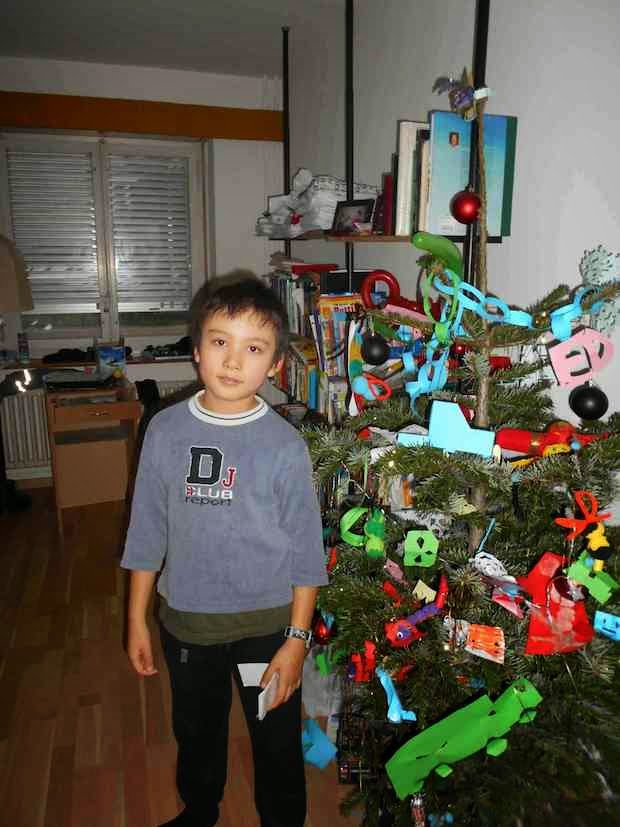
Decorating the Xmas tree
Controlling a toy plane
In 10 years from now David will go to college. It's hard to imagine him as an adult or even as a teenager. He is still a little boy who cries/complains/growls easily, and needs plenty of hugs from grandma. My hugs are best when grandma is not around, but he does love and admire me, too, and he misses his mom. We would like it if he paid more attention to what we tell him, and if he would not have to be asked 10 different times every time he needs to do his homework or needs to get dressed. Also, it would be nice if he paid more attention in school, if he was overall more organized, and if he did not lose his swimming suit quite so often.  However, I am not ready to have him all grown up just yet. Time does seem to pass too quickly as it is.

I close with a quote from a modern adaptation of The Cat in the Hat that was sung this morning as I was waking up:

"It can be done. It can be done
Anything, anything under the Sun".

They sing thus when we go to the store, too. It does help me (especially in the job applications season) that they are so optimistic and full of life, and that my mother is with me to help me raise them. I hope David will be able to retain his optimism and at least some of his ambitions as he grows into a man. In the meantime, for the sake of the neighborhood I may consider investing in some music lessons for him and Edward.


Thursday, January 29, 2015

A job search from 88 years ago

I have just found this letter among a pile of old pictures, and decided to post it. It was written by my grandfather's brother, Teodor, who had just finished law-school and was looking for jobs. This was almost 90 years ago when Teodor was 25. Below is a rough translation of some of it.

The letter
"Beloved Brother,

On January 29th, 1927 I saw all my hard work from highschool and university bear fruit as I took my solemn oath in front of the highest court in Bucharest (curtea de Apel). I felt humbled and grateful to an extent that is impossible to describe in words. My soul was full, and in that solemn day, it seemed that all my blood went to my head and I was prepared to go straight to work and work hard as a lawyer. I felt such happiness! I will forever be grateful to God, and to my beloved parents for their work and sacrifices, which made this noble and exalted mission in life possible.

When I wanted to leave the room in which I have taken the oath, I noticed with profound sadness that my silk scarf was missing. I received it as a gift, and it had felt so very pleasant to wear. The solemnity of the day did not permit that I dwell on this loss for long or attempt a recovery.

In 1927
Now that I had the diploma in hand, I started searching for a place to enter life as a lawyer. It does not surprise me that all my efforts so far have been in vain. In Bucharest, I have been talking to many deputies and legislators. Everything I do turns out to be useless.

I have then been persuaded to travel to Timisoara. Overall, I have met many disagreeable individuals who are very limited in their views of life and of the world, and yet hold positions of power and call each other "doctor". This title is beautiful, but you see something is missing. A title hides ignorance just as well as complicated words hide the lack substance. I searched endlessly as I entered the offices of these insects for some place for myself. It was impossible!

[... He tries obtaining the help of G., whom his father had supported through school, and this fails as well. After studying economics, G. had opened a bank that was guaranteed by my great-grandfather, and by many other people in their village. The bank failed a few years later, and the villagers (including my great-grandfather who died soon after) lost most of what they owned around 1929. Later G. recovered and built a hotel in Bucharest...]


Soon uncle G. started criticizing us. He told me that my brothers and I want too much from life, and that we should have started working sooner and at a lower level instead of going to university. He judged me as if he had raised me or paid in any way for my education when I have seen with my own eyes that neither was the case.

G. has many acquaintances on which he can count on only as long as he has money. Afterwards, they no longer remember him. Even now that he appears to have lost everything, he will likely recover through other unclean schemes. However, I do not believe he will be succeeding in the long term. Even though he first reached his position on my father's money, and we loved him and believed in him, he disparages us, and has never tried to help us in earnest. His attitude will not change with circumstances.
"

It is hard to write a translation that does justice to the original prose. When I read his letter, I feel some of his personality coming through. When I read my translation, I feel my personality in some of the same words much more than I feel his. While he appears excited about starting life on his own and prepared to work hard,  he also comes across as an idealistic college graduate with a sense of humor who is frustrated by his job search, and by the political situation. He tries to be a force of good in the world, but he is still very young, and quick to judge and condemn. My favorite part of the letter is where he refers to the lawyers/attorney from the various offices where he applies for jobs as insects. I relate to the struggle and sometimes to the feeling that everything is meaningless/useless. I suppose that part is timeless.

The background story

The family around 1920.
My grandfather had four bothers and two sisters. Teodor was the second of four boys. They lived in a small village called Semlacul Mare (close to the border with Serbia) that produced corn and grapes. It must have been very difficult for my great-grandparents to raise four boys so close in age, and send them all to school. There was a strong bond between the four brothers that must have been almost palpable. It therefore seemed natural for them help each other, and to get into mischief together.

A picture of Teodor at about 13 is below. It must have been taken in 1914 - close to the beginning of the first world war. He looks uncertain and afraid. It was not common to have to sit for photographs.

Like most of the family, he had big green eyes and brown hair. My grandfather, Mihai, and my great aunt all had the same eye color, and his eyes are likely to have been the same shade of green. He was also funny, mischievous, and charismatic with a beautiful smile - the kind that lights up the whole face and can temporarily stop hearts from beating.
8th grade

When Teodor left home to go to highschool, he pretended to be Romanian nobility in order to be treated more  respectfully by the host family, and allowed to sleep late. Unexpectedly, his father came to see how he was doing. The mistress of the house where he was paying for room and board told him "Sir, please, do not disturb. The baron is asleep", and it was noon. Apparently, once Teodor heard his father call his name, he was awake and dressed in no time, and his stint playing a baron's first son was over.

Quoted conversation between my great-Grandfather and his eldest son, who was of a quieter nature than Teodor, and also ended up being a lawyer:

Father: "Why can you not be more full of life ... more like Teodor?"
Son: "But, father, Teodor upsets you."
Father: "He upsets me, but I like it!".

Later, my great aunt (who was 13 years younger than him, and became a mathematician) was known to tell him:

"Teodor, please, talk to me and pay attention to me when we are together in public. People do not know that you are my brother, and pity me when they see you keep looking longingly after every pretty woman that passes by. They think, poor girl, she is not beautiful or interesting enough to hold his attention."

He came to her highschool graduation exam, which was a public event. She remembered him exiting the room grasping for air and waving his hat like a fan. She had been a very shy child, and he suddenly felt the need get out of the room when his shy little sister started speaking. They were all so very proud that she passed.

Epilogue:
Back of the photo records his birth and death
Last photo
Teodor did find a job as a lawyer in Ploiesti, where Romania's biggest petrol refinery was located. He was assigned to represent the state, which was the highest honor for a lawyer. His best friend and colleague was Salvador Bradeanu, one of the best professors of law from that era, who was certainly not limited in his thoughts or in his understanding of the world. They had both studied law in Paris and remained life-long friends.

This is a short love letter he wrote:

"My wandering, unhappy soul cannot find rest
unless it lies close to your breast,
beloved woman.

To you I surrender my love life forever.
Teodor. 24 December 1933."

He had sent this poem on the back of a picture of himself to his wife on Christmas-eve.  It was eventually returned to us.  In Romania, it was common for women to carry photos of their loved ones close to their breast up to the mid 1990s. When I was in middle school, I had a classmate who used to carry pictures of Michael Jackson close to her heart. Of course, we were silly school children, while he wrote this to a woman close to my current age, and it seemed that he had really loved her. However, ideally, at 36 he should not have been so alone - he should have had a wife and children and found some means for happiness outside work. But then it is foolish to judge so many years later while not knowing him or the circumstances.

I do not know whether the love letter was written before or after he divorced his wife.  Teodor had married a widow, and after marriage they lived in the same house as her former father in law, who had significant political power. Soon, he found out that his wife was having an affair with her ex-father-in-law, and divorced. The divorce was quick since he was a lawyer, and they had no common property or children. But even though they had separated, he continued to care for her and sometimes met her in secret. My grandmother, who had met the lady and the father-in-law and had been very impressed by his automatic-electric gate, which was remotely controlled, believed she was likely forced by circumstances to have the affair. Teodor also came to regret being impulsive and divorcing, and later did not blame her for the affair.

He was murdered in 1937 - ten years after obtaining his degree in law. After finding out that Teodor was dead, his ex-wife seemed devastated and asked his brothers "why did you not tell me?". They did not involve her in the investigation that followed, and eventually gave up the search for justice after being told that they will all die if they continued. The last person to see him alive had been his best friend, Bradeanu, to whom he confessed that he thought he would be killed that night. Bradeanu offered to go home with him, but Teodor told him to think of his wife and child, and to go home to them instead. Later Bradeanu would recount Teodor's last day to my mother, who was a resident doctor in Bucharest.

Teodor had obeyed his solemn oath up to the end and refused to be bribed into losing a trial for which he had the legal proof to win. He was educated to always be fair, to put his country and his work first, and to prefer death to dishonor. It was a period when many bright individuals died for being too brave or too fair or just being at the wrong place in the wrong time. Through death he was spared of witnessing the many tragedies that followed. He was, however, missed by his brothers and sisters for as long as they lived.

Tuesday, January 20, 2015

Stellar Collapse in Semi-classical Gravity

Core-collapse simulation image (Philipp Mösta)

Supernova explosion (artist: Mehau Kulyk)
In the simplest stellar collapse model of classical General Relativity developed by Oppenheimer & Snyder 1939, the collapsing star is idealized as a uniform ball of dust that contracts under the pull of gravity. The dust particles that make up the star are assumed to be classical and thus infinitely small, infinitely light, and interact only gravitationally with other matter. This approximation is not perfect since infinitesimally small particles would be infinitely large in size, and could never be localized within the stellar horizon.  

The inclusion of quantum effects is unavoidable both when determining whether a black hole will form and when understanding the final stages of the stellar collapse. When we include quantum effects (arXiv:1501.04250, submitted to Physical Review D),  some of the assumptions above are lifted. A particle on the surface of the star is no longer localized, but is instead represented by its wavefunction. Every particle now has a finite probability of escaping the gravitational pull of the star. This allows for the possibility that some configurations will not collapse to black holes, but will instead disperse or even form stable new configurations. The smaller the mass of the constituent particles, the more significant the quantum mechanical effects become.

Classical paths with all initial velocities
To simulate the stellar collapse using a path integral formulation, we have to integrate over all possible paths towards and away from the center of the star. This includes classical paths with all initial velocities. In the special case of the dust ball collapse these paths can be computed analytically.  We first derive analytic solutions to all classical paths (space-like, time-like, and light-like) in Schwarzschild (Table I and II in arXiv:1501.04250) and Kruskal coordinates (see Table V and VI).


The evolution of the wavefunction
In Schwarzschild coordinates, we can only study the collapse outside r=2M. The motion of the particle on the surface of the star is analogous to the vertical motion of a ball moving under gravity, which can go from an initial point to a final point directly or reach its highest and then come down or escape. Each of these paths is unique taking a different amount of time to complete.

In Kruskal coordinates,  we can model the behavior of a particle on the surface of the collapsing star up to the physical singularity at r=0.  We find that classical time-like paths are unique. A path between an initial and final point can be either direct or indirect (turns back in space). Thus some particles that initially move away from the star can return and contribute to the collapse. Space-like paths can turn back in time, but cannot turn back in space. They are also no longer unique when the final point lies inside r=2M. Classically, no information can exit the black hole. However, by integrating around the classical paths one might be able to extract information from inside the horizon. We only compute the paths in the Kruskal case, and leave the computation of the wavefunction and full exploration of the quantum collapse to future work.

The minisuperspace approximation
Models that apply quantization procedures to general relativity operate in superspace, where a 4-geometry space is represented as a trajectory within space-like 3-geometries. A minisuperspace is a symmetry reduced space where these trajectories are limited to a finite number of parameters describing the constant t slices. We assume that the radius is the only spatial degree of freedom that is not frozen. Such restrictive approximations make the problem tractable analytically. Most physicists reading this have likely worked in minisuperspace unknowingly.

The wavefunction of a particle on the surface of the collapsing star


WKB & Schrödinger comparison
t=5 M, multiple masses
The initial wavefunction is taken to be a Gaussian centered far away from r=2M.  In Schwarzschild coordinates, we then compute closed form solutions to the propagator in the WKB approximation where an expansion is performed around the classical paths and in the Schrödinger approximation, and compare the resulting wavefunctions. We find that the two solutions converge towards each other at intermediate times. They are out of step at early and late times with the Schrödinger solution being more exact at early times, and the WKB approximation being more accurate at late times. For lower particle mass, the star resists collapse longer and the probability that it disperses increases. Further work is needed (including the addition of higher order corrections to the Schrödinger solution) to determine the mass limit at which stellar configurations no longer collapse.
M=0, dotted (WKB), solid (Schrödinger)

In the limit when the mass of the star is zero, the WKB approximation converges to the Schrödinger solution at all times. This checks that the WKB approximation is accurate. The Wheeler-DeWitt equation converges to Schrödinger equation in this limit making the Schrödinger solution the exact solution of the free particle problem (Redmount and Suen 1992). Note that Redmount and Suen did not find a good agreement between their WKB approximation and the exact Schrödinger solution due to numerical issues.
 
Black holes, black stars or boson stars?
The dust ball collapse is a testbed for relativistic corrections to the Schrödinger equation. Recent work by Dvali and Gomez argue that black holes are a collection of Bose-Einstein condensates. Quantum effects are very important in this situation, and could add potentially new semi-classical corrections that can be investigated.

Other authors argue that there are no black holes and that nature has black stars or boson stars instead. Neither have an event horizon. 

Classical boson stars are formed from dark matter particles that are spin zero bosons and Bose-condense creating a macroscopic quantum object that depending on the particle size can either fit in your pocket or be the size of a galaxy. Since no spin zero particles have been discovered other than the perhaps the Higgs boson, it is difficult to predict which theory is correct. Supermassive boson stars could lie in the centers of galaxies. Upcoming instruments sensitive to light may detect supermassive boson stars through lensing (e.g., see Boson stars as Gravitational lenses and Method for detecting a boson star at Sgr A* through gravitational lensing). In the future, it may also be possible to detect gravitational waves from a pair of co-orbiting boson stars. Additionally, detectors beyond LISA may see gravitational waves from perturbed supermassive boson stars, which would have quasinormal modes that damp slower than if the object had been a black hole.

Macroscopic dark matter particles?
Feeding on dark matter?
Dark matter particles come close to the attributes of classical dust. If somehow black holes can feed on dark matter particles,  the paucity of super-massive black holes immediately above a certain mass M could be linked to the presence of an ultra-light particle halos that black holes heavier than M can feed on. Black holes lighter than M would be unable to capture such dark matter particles in the same way mini black holes produced at the LHC cannot be grown on atomic matter and pose no danger to the Earth. As soon as a black hole reaches mass M, it starts feeding on dark matter and grows rapidly, perhaps swallowing the entire halo. It is important to note that unlike virialized dust halos or stars, the super-fluid dark matter particles would have negligible momentum and thus accrete easily.

Why should we care about black holes?
Supermassive black hole. Artist conception.
In order to understand the universe, we have to understand black holes. They are the most permanent objects in our universe. All life revolves around them. Every galaxy has a black hole at its center. In the early universe, black holes acted as the seeds around which material collected, and eventually galaxies as complex as our own formed.  Black holes are also believed to be the only objects that will be left in the very far future as our universe continues to expand growing cold and empty. They do evaporate, but the evaporation of black holes that are stellar mass or higher happens on timescales longer than the age of the universe and thus is not observable. To truly understand black holes we have to understand their quantum nature, which is not only important in understanding the final stages of stellar collapse, but also in understanding whether they will form at all. The lighter the constituent particles, the more important the quantum mechanical effects become.

This post is based on arXiv:1501.04250, which is work done in collaboration with Prof. Jayashree Balakrishna (Harris Stowe State U.) and Dr. Christine Corbett-Moran (Caltech), and has been submitted to Physical Review D.

This is the first article I have written where all the authors are women. It is also coincidentally my most technical article to date. Note that my co-authors and I do not discriminate and believe in equal rights for everyone. Our collaboration just happens to be 100% female this time.