Thursday, January 14, 2016

Can we make life better for graduate students? The two advisor trick

The latest reported sexual harassment case occurred at Caltech with a professor I had known and thought very highly of. Caltech issued the typical response saying that they have "zero tolerance for sexual harassment".  Scientists across the world agree that departments turn a blind eye to various forms of abuse (see We Suck (but we can be better) by Sean Carroll or Something deeply wrong with Chemistry from some time ago).  I believe that it is timely to brainstorm, propose and implement changes that improve the life of graduate students (and postdocs).

A hiking trip
my best friend from grad school and I
My PhD  advisors were Ira Wasserman and Saul Teukolsky (Saul is also on wikipedia). They were both full professors at the peak of their careers. When I was their student, Saul was the head of the physics department and Ira was the head of the astronomy department. My thesis was on the nonlinear dynamics of R-modes, a type of oscillations driven unstable by gravitational radiation emission, in neutron stars.  Every time I stumbled and one of my advisors would say something discouraging, the other would give me the hope I needed to move on.  Since they complemented each other quite well, I cannot imagine finishing my PhD with only one of them.

Multiple committee members is a common requirement for most universities, but a dual advisor system is not. The committee members are people a student sees in exams (universities typically have a qualifier exam, a thesis defense, and sometimes an exam in-between that presents the thesis idea) and to get signatures. These entail a few meetings over a period of five or six years. The advisors play a much more important role. They regularly meet with the student, and shape her or him into the researcher she/he becomes. Most often professors do not mean to hurt their students. They hope to teach them everything they know, and want to make sure that what comes out of their group is daring, correct and as perfect as it can be. It is hard for a student to make the difference between legitimate concerns about performance or scientific goals and a personality conflict. Yet to progress one must act on valid criticism and have reasonable expectations on both the scientific goals and how much work is necessary to achieve them. A second opinion from someone with equal power and experience who understands and is part of the project can be crucial at preventing many types of problems.

On top of Space Sciences: Dave, me and Andy
the office next door: Ali with the others
I was a PhD student at Cornell between 2003 and 2008. In the physics department, we were four women in a class of over 40 students and at universities who actively try to recruit women, the situation is similar today. I enjoyed my time there among many talented overachievers. When I was a first and second year graduate student my friends and I watched Kip Thorne's gravitational wave lectures that had just been recorded by my brother, went hiking, and frequently talked about science. We were thrilled to interact with the brilliant Cornell professors on the same floor (the rest I did not see unless I took a class with the person), and with incoming speakers over lunches and dinners. My science discussions with Andy, Mihai and Dave eventually resulted in a paper on the importance of finite mirror effects for advanced LIGO detectors that was published in Physical Review D. I had worked on other projects before and after this, but this paper was the only project with no senior people on it, i.e., where none of the authors had a PhD to begin with. We all hold PhD diplomas now.

Why two advisors?  
Two people are less likely to make the same mistake. Emails and meetings on the details of a project include all collaborators, which typically prevents people from sharing personal or harassing information, and when there is a problem you get it explained in two different ways by two very smart people.

Typical problems
1) Very long PhDs or no doctorate degree after many years of working on a project.  I have had an office mate who worked on his PhD for ten years and yet did not have time to publish any of his findings in a journal.  There were also plenty of people who did not graduate at all. If after a number of years (sometimes up to six) the research is not deemed successful, students receive a masters. A masters can also be achieved in one year of study; I got my first masters in one semester, but this was atypical. Projects that last too long are a sign of mismanagement.

2) Taking too long to read a paper written by a student & allow the publication of the results. This is quite common. It is also extremely stressful and frustrating. While the paper sits on the advisor's desk, it can happen that somebody else produces the same results and the student has no thesis left at all or that the methods/equipment used change to make the problem obsolete.

3) Obvious mental problems. Both the student and/or the professor can have mental problems ranging from depression to bipolar disorder to other forms of problems. I have limited experience with such situations. If you have two advisors, it is unlikely that both will suffer from the same thing. If the student is ill, it can help to have two people to rely on. Either way, emails sent to/conversations that include more than one person prevent harassment.

We had a professor at Cornell, who was very talented, but on alcohol & drugs. His problems were known to everyone in the department, and yet he had four students. Two of his students quit science without a PhD. The other two had the strength to continue after he left and were encouraged to choose new advisors. Unfortunately, this was four years later, and so the duration of their PhD extended, too. If they had more than one advisor to begin with, the sane person could perhaps have taken over or at least provided some advice and support.

4) Unhealthy competition. If you work with two smart people, they may help you gauge what is important better.

5) Sexual Harassment. It has recently been estimated that close to 90% of women suffered from some form of sexual harassment in the tech community (estimate based on a sample of 200). The numbers must be similar in technical fields in academia.  A two-advisor model provides another person to turn to if there is a problem in the department. It is also less likely that a colleague/professor would harass a student in group meetings or through group emails. More people in the group/room and more diverse groups help diffuse awkward situations. If a person behaves inappropriately, they have to be removed from the project for the group to function fairly.

Attraction is common between people, and it has to be acknowledged that we do not choose how feel, but choose how we act. Different people react differently when they are attracted to someone. Some are kind to people they are attracted to, and some make unkind comments and put them down. The latter category is surprisingly common and causes more disturbances in the work place than the former. It is hard to control this behavior that comes naturally and may in part arise due to repressed feelings by telling people to repress their feelings more. Training may help, but I worry it only has short term effects.  I do not believe that someone can change their personality because it is part of who they are; a "training to be nice" program that starts at the age of 45 or 50 is not likely to work efficiently. On the other hand, choosing people who are compatible in the first place to work together should make a difference.

So far (in the past 20+ years) we have not made (much) progress towards equal treatment & equal numbers of women and men in the technical world or towards making the work environment more healthy for everyone. On the bright side, most of the hassles that I have to face today are likely to be less than what my mother/grandmothers/great-grandmothers faced years ago. Most women can work, vote and drive, and with no major upcoming war, things should get better if we actively try to change dysfunctional programs.

Drawbacks of the two-advisor model.
Few professors are as kind and as talented as Ira and Saul. My friend and colleague, Ali Vanderveld tells me Ira and Eanna Flanagan made a wonderful two-advisor team, too, and I am sure there are other people out there who were happy with such graduate school experience. But there will be cases when this does not work well. If the professors do not get along, the student may be pulled in different directions and forced to act as a mediator. Sometimes a less senior person works (e.g., a postdoc) with the student, and the professor is on the paper because he provides the funding and work-environment, but little else. This is less likely to happen at top US institutions, but more common in Europe. In this case, it may not make sense to add another uninvolved person to the work. In smaller universities, there may not be two professors who work in the same field. Then the second person would have to be external.

Thursday, November 26, 2015

World-news - the fall of 2015

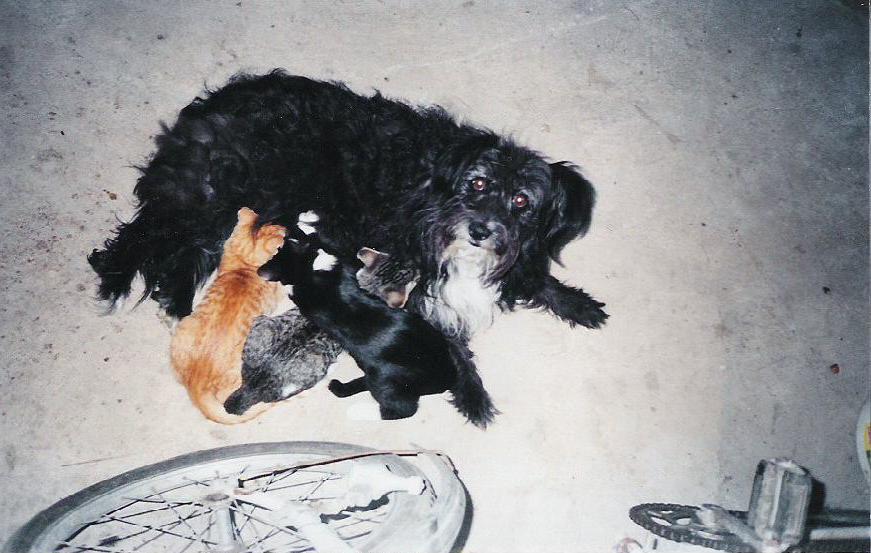
I have no good cat picture, but this is Blacky nursing kittens.
It's hard to find the 'right' words to describe tragedies.  I only hope that the world I live in will not blow up any time soon. My favorite news program remains the Onion explains. I think they do a better job of presenting the political situation than I ever could.

So, people fight in the name of religion. What do I believe in?
I believe in being kind. I think we all have some inner strength that shines through at times. This is more obvious when we do things that at first appear impossible.

I am a scientist, and so I know that the world did not start with Adam and Eve. Life started with bacteria. Once more complex systems appeared, they grouped themselves together to be stronger.  People do that, too.

Religious groups have thus been around for  a long time. They promote a strong connection between their members through some deit(y/ies), but are all invariably outdated in their beliefs, e.g., the world is not 6000 years old, it is not right to marry underage children between themselves or to old men or have children with your father.  What such groups have in common is that they all say they promote kindness, which is often reserved to the people in the particular religion to give it more power.

To strengthen, enforce and display power, people perform violent acts. They then use this violence to promote themselves, and the organization they are part of.  In the past, people were burned at the stake in the name of God. Now, beheadings, bombings and mass shootings are coordinated in the name of Allah. Neither Allah nor God are obviously directly involved in these crusades, but the acts of violence have more power if they are done in the name of a deity. They can be then be seen as 'divine' revenge for wrongs committed in the past, which result in more killings, more opportunities for revenge, and often respect and idolization of the people perpetrating the violent acts.

 A deity remains a beautiful name for our ignorance in the same way dark matter and dark energy beautifully label 95% of the energy density of the universe. We gave the dark sector a nice name that does not make us understand it better, but it does help in obtaining funding for experiments. Beauty in a name is powerful especially when we do not know what we are naming. Who would fight and lose their life if they were told they simply further ignorance?

Humanity will always need people who promote kindness.  Ideally, the job of a religious institutions is not to judge and condemn, but help the communities they serve. I was disappointed to say the least with the response of the Orthodox church to the Colectiv disaster.  Anyone who says that people who listen to music deserve to be burnt alive should not be heading a church or any other public institution. They reminded me that patriarchs and priests are humans who are often both wrong and representative of a faulty system. I have, however, met a number of kind and talented priests. I try to remember them instead independent of denomination.

Shootings in the US. 
Mass shootings have been 64 days apart in 2015 and have increased in frequency since 2011. Some perpetrators are Arab, but many are white;  Slate.com writes an entertaining article about the white mass-murderers from North and South Carolina. Part of the problem is that these criminals become media sensations, and still nothing is done to prevent such events from happening in the future.

The last mass shooting was in San Bernandino. It impressed me more than the others because I remember driving through San Bernardino with my brother when he was a PhD student at Caltech. The perpetrators were a young Arab couple with a six month old baby. They murdered 14 of their colleagues at a party for the disabled.

I see it as important to stop turning criminals into media sensations. They should be statistics without faces. Whoever these people are, they do not deserve the press they get. The notoriety only attracts more criminals, who perpetrate similar acts in hope of leaving their mark on the world. I do not care who their family is, but I do believe that, in general, children should be removed from extremist families, and placed with families that do not suffer from this pathology. Beyond that I do not want to know their names, their hobbies or what their brothers/sisters/parents think.

Do I believe there will be a 3rd world war? No! I do not see reasons for a war between Russia and Turkey, Europe, and/or the United States. Since we won't see another doubling of the population, there should not be competition over resources. Moreover, each of these countries has the weapons to create major disasters on Earth, and the 'purpose' of those weapons is to prevent a war between weapon-holders. The competition for the power exerted by the chosen few over the rest of the world is ongoing with focus on the Middle East. While there is some conflict in Ukraine, I expect there is no need for a major re-drawing of borders.

More unrest in the Middle East?  I used to think that the next country to go into anarchy would be Iran, but now it seems that Saudi Arabia will perhaps fall next.

Low birth rate? More migrants
In the past, epidemics and the lack of food enforced population control. Smarter parents had children with a higher probability of survival because they usually produced and managed resources better. Now that the probability of survival is high, communities who enforce religion have children, and those who do not fail to reproduce. The more extreme the religion (i.e., the crazier), the more children they have. In countries with high levels of education, religion works only to a limited extent. So, there not enough people to perform poorly paid jobs, and we rely on immigrants. The US has the Mexicans for low paid jobs, and continues to try to attract some of the best and the brightest minds from all over the world for the higher paid jobs. Europe has migrants from the Arab world with the latest wave being from Syria. The latest wave was too dense and so very hard to deal with, but it should still lead to economic growth and to progress.

Limiting Climate Change: Alternative energy sources? Better transportation? There is a need for work in many directions that do not involve war. We have to slow down climate change, and yet integrate, educate, and bring the rest of the world's population above the poverty line.   Bill Gates writes an inspiring note after the Paris climate change talks and discusses a paint to turn any surface in a solar panel among other things. The investment in solar energy is growing in the US with Solar City proving installations for both businesses and private residences. Elton Musk plans to build a new kind of railways called the Hyperloop on which trains will be faster than planes while relying on solar energy (i.e., virtually no pollution). A hyperloop prototype might be ready by 2017. Mihai (my brother) said that Hyperloop would be like a huge LIGO detector, and turn out to be very expensive, but I am hopeful.

The next US president?
 The presidential race continues to be like a bad movie. Donald Trump's strategy relies on getting people who hate other people to identify themselves with him and vote for him. Historically, this type of strategy worked well over and over, and it really should not be surprising that it is working again. It is just that as educated individuals we believe in equality and in some kind of utopia where people are not so vulnerable due to the many things they hate.

Canada: the country of the year. One of our visiting faculty once told me that Canada is the best country in the world, and I am now inclined to agree with him. I am proud of Canada, and of their government (50% men and 50% women). It will be interesting to see how they succeed in integrating  25, 000 Syrians over the next 3-4 months.

Missions: LISA Pathfinder was launched successfully! News about LIGO's first gravitational wave detection are expected soon!

Monday, October 26, 2015

Clocking in: Christine's Egg Freezing Adventure

Photo credit: http://www.vogue.com
We often hear about egg freezing as a recommended option for professional women who want to postpone having children to their late 30s or 40s or perhaps even later. Christine is brave enough to both go through this process and write about it so that we can have the details of what it entails.

A bit about Christine
Read Part 1 of her post here.
Christine did her PhD at the University of Zurich, and I was one of her mentors and collaborators.  She is an amazing researcher who was invited to meet President Obama three days after her PhD defense. She is also the first PhD I wrote a letter of recommendation for. I particularly enjoyed writing that my opinion of her abilities is seconded by that of the president of the United States of America.

Christine is now a researcher in astrophysics at Caltech where she holds a prestigious fellowship from the US National Science Foundation. She flies planes for fun, and is scheduled to be in Antarctica for one year starting in January 2016 for training and research.

My favorite part of her post is her statement that women come with a built-in 3D printer that creates people, and that men should be begging to use it. That is simply sublime, but I should and will refrain from elaborating further.

Note that this is a very personal choice, and we each have the right to make our own choices. It is not OK to insult or write abusive comments.

What is my opinion on the subject? Egg freezing is a good plan B if a woman plans to have children after her mid-30s. The age of the mother at the time the eggs are harvested plays a crucial role in determining the success rate of the procedure.  There are, of course, in any age pool some people who succeed naturally, some who need treatment and for whom the treatment works, and some for whom IVF fails. Young frozen eggs increase the probability of success when IVF is needed. They do not guarantee success.  This treatment is quite expensive, but, if the patient is young and healthy enough, it may be financed by selling some of the eggs.

All the female professors I have met who have families and have led discussions on the subject, regretted not having children earlier, and building a life around them vs. waiting for tenure or some other poorly defined "right time". After having a child myself, I agree with them.

Advice from Tusa Tavi
My last conversation with Tusa Tavi (the sister of my grandpa) went along the lines:
me: I passed my qualifier exams today! 
TusaTavi: That's nice, but you do have a university degree.
me: I do. I also have a Masters, and I am working towards a second Masters and a PhD.
TusaTavi: Then you can support a child.
me: I cannot have a child alone, and right now there is nobody in my life with whom I would want to have and raise a child.

TusaTavi: Well... go to class and drop a pen. See who picks it up. If you don't like them, try again.

Octavia - middle-aged
Grandpa, Mom, Ionica, Tavi & Mariana
Tusa Tavi then reminded me that she had helped raise many children above and beyond her job as a Mathematics professor.  Her last protege was still in kindergarten. Children loved her because she had always found the time to take them seriously, and listen carefully to everything they had to say. She had been there for her family, friends and neighbors, and for a number random people she met who needed her help, but the one thing she regretted was not having had a child of her own. She thought it would not have mattered so much with who. Most of the suitors had been educated and kind or seemed so from her stories. Once she had a college degree, she was able to both support herself and help family, and she thought she would have been able to support a child at any time since then. Part of her message was that she believed I could do it, too. She said that, anyhow, I should expect to do most of the bringing up myself and so I should not wait too long before starting a family.

Years later with her husband
Octavia - young
Tusa Tavi had defined propriety for me. She had always emphasized the importance of being both correct and gentle. I spent my girlhood listening to her stories. She had married late and had had plenty of suitors before that - each with a funny story of his own. She and my uncle met and started a courtship before the second world war, but only married 15 years later. At the very end, she did not regret any of her suitors, but simply wished she had had more strength and courage herself.

 She died before I went back home to visit and so we never spoke again.  She was 90 and I was 22. 

Saturday, October 17, 2015

Looking for Aliens

Ravi Kopparapu visited Zurich some time ago and gave a very interesting seminar that summarized the latest work in extrasolar planets. Some of the things I've learned are below. Note that the title comes from the description that Ravi's daughter gave of this. The actual talk title was "Habitable Zones and the Occurrence of Potential Habitable Planets in our Galaxy".

When is a planet Habitable? 
Habitable zones [Image from Ravi's website]
 A rocky planet is potentially habitable if it contains water. In our solar system, the Earth is located close to the inner edge of our habitable zone (also known as the Goldilocks zone). Mars is located close to the outer edge.  The Moon is outside our Goldilocks zone.

Ravi (together with James Kasting from Penn State University and others) built a calculator for finding habitable zones around different kind of stars. The brighter the star the further way the planet has to be to be habitable. The coolest types of stars are M-stars or red dwarfs. They are numerous and dim, and so the habitable planets in their orbits can be closer in. Planets around M-stars are also tidally locked. This means that they rotate synchronously just like the Moon does - always keeping the same side towards Earth.

Close to the inner edge of the Habitable zone, the planet has a water dominated surface like Earth. At the inner edge, the planet is so hot that most of the water has evaporated to the atmosphere, then it is no longer habitable.  At the outer edge, the temperature is low, and no amount of carbon dioxide will warm up the planet to melt the ice. For a star like our Sun, the inner edge of the habitable zone was first found to be between 0.97 to 0.99 AU, while the outer edge is at 1.6 AU. However, this model did not include could feedback.

3D models also include clouds, which reflect some of the sunlight and allow the planet to be slightly closer to the star. The inner edge of the habitable zone for a Sun-like star shifts to around 0.93 to 0.95 AU, whereas the outer edge remains unchanged (1.6 AU). Mars is at 1.5 AU, while Venus is outside the habitable zone receiving about twice as much sunlight as Earth.

It has been known for a long time (1996) that there was ice at the Martian North Pole, and beneath the surface at the South Pole. Structures and rocks on Mars also suggested the presence of flowing water. But there was no direct proof of water flowing now on the surface of Mars until the Mars Reconnaissance Orbiter has found hydrated salts. This means that very salty water still flows occasionally on Mars. 

How many planets have been found in Habitable zones?
There are about 30some known planets in the habitable zones of other stars, and out of those about 10 are Earth-sized. The numbers are so low because current technology does not allow us to see most of them, not because the planets don't exist.

How do we estimate habitability from so far away?
Life interacts with the atmosphere. We would expect to see the same kind of gases as we observe in the Earth spectrum: Oxygen, Carbon dioxide, water vapor, ozone, methane, and dominant nitrogen. Plate tectonics is also very important.  It causes volcanism, and volcanoes are believed to be what got our planet out of the various ice-ages.

Life under-surface would not interact as easily with the atmosphere, and would be harder to detect from far away.  

Snow Ball Earth
The Earth is believed to have had many ice-ages (C-Si cycle). About 700 million years ago, our planet was a snow ball. The the ice was 1 km think and reached the Equator.  There are a number of proposed triggers for the ice age - one could be the eruption of a super-volcano like Yellowstone. The carbon dioxide is taken away from the atmosphere into the subsurface of the Earth. It is called the Carbon-Silicate cycle where the surface Silicates are converted to carbonate sediments. In time carbon dioxide accumulates in the atmosphere again and the ice melts. 

How many planets do we expect around a given star?
Every star should have at least one planet of any kind orbiting it. Planets are common. They are not an exception. They exist around every star in our galaxy.

Then...
The first Earth-like planets were found more than 20 years ago. In 1992, it was found that planets could orbit pulsars. This shifts the center of mass of the system. The pulsar then wobbles around the center of mass causing millisecond delays in the pulse arrival times. 

Twenty years ago (in 1995)  Michel Mayor and Didier Queloz (Geneva Observatory, Switzerland) found the first extrasolar planet around a Sun-like star. 51 Pegasi B became a prototype for a new class of planets - the Hot Jupiters. They are big like Jupiter, but orbit very close to their stars, which induces high surface temperatures.  These planets were first found via the radial velocity method, which measures the velocity shift in the spectral lines of the star induced by the planet's gravity.

Both the temperature and mass of 51 Pegasi B are Sun-like. It has a surface temperature of over 5500 K. The light it reflects from its Sun is in the visible spectrum, and can be detected from Earth. Recent work suggests that this planet could pioneer yet another way for finding nearby extrasolar planets.

Now....
Today some 4000+ planets were found. Most were found by NASA's Kepler mission in 2009-2013 via the transit method. When the planet crosses in front of the parent star disk, the observed brightness of the star drops by a small amount. Three transits should be observed to confirm a detection.  For our Earth, a far-away alien civilization would observe one transit per year. The mission duration of four years was chosen so that Kepler could find Earth-like planets around Sun-like stars.

 How to find Alien life?  
 Keep searching and keep an open mind...

Kepler has recently found a star with an unusual a-periodic pattern. Two hypothesis were put forward: (1) a swarm of comets that are perhaps a remnant of a kind of collision and (2) an Alien
Mega-structure that perhaps consists of solar panels used by some very advanced alien civilization.
So, have we found aliens. Well... of course, not, but more data is needed, e.g., infrared and 
radio data. This is the first reasonable candidate that could be used to develop SETI methods. It is very reasonable that some more odd balls will be found when looking for planets.

Perhaps we will look at the atmosphere of habitable planets and find life outside the solar system that way or perhaps there will be some satellites built by aliens that we will see around the stars that host habitable planets. Either way it is timely to start taking SETI research seriously.

Other news
Geoffrey Marcy who led the research team that discovered the first planetary system around a Sun-like star resigned his professorship under pressure after allegations of sexual harassment. He went from being known as the finder of new worlds and being nominated for the Nobel prize to having to quit his position at Berkeley. He was also a co-Investigator of the Kepler mission. He is thus a person who changed our understanding of science.

I did not know him, but apparently his behavior had been an "open secret". So, why put the pressure now? did he disturb important enough people with unrelated behavior? was he not productive enough (he is 61) and so it did not make sense for the university to continue to cover his apparently non-criminal indiscretions? does it makes more sense to hire someone else on his position at this point? is it a combination of factors? Or is it really about setting a zero tolerance policy to sexual harassment in universities around the world? I have given up trying to understand politics for some time, and I want to think even less on these issues now that I am applying for jobs again.