Saturday, December 7, 2013

In Warsaw at GR20

The library with Maxwell's equations
This post is obviously overdue since GR20 was a conference that happened last summer. But I thought it better to write about it now than never. The GR meetings are the biggest conferences in the field of gravitation. They are attended by many scientists from all over the world who give many oral and poster presentations. So, I  will not aim to describe everything that happened since that's impossible. I will just write about what I remember.
Mihai next to our apartment

I gave a talk on the atomic clock work and we also had two posters. One on cosmology and another on Chameleon models and STE-QUEST written by Andreas, my first student. STE-QUEST is a medium size mission candidate to be launched by ESA in 2022+. This mission would investigate the behavior of time and matter near Earth by using an atom interferometer and atomic clocks.

me on the day of my talk
In terms of setting, Warsaw is beautiful in July. We rented an apartment in a building with high ceilings that felt very much like being home. We each had our own room, and it was cheaper and better than a hotel. The "us in front road construction" pictures were taken for Edward and David who are still fascinated by bulldozers, and because Mihai and I like construction sites, too. We saw the benches that each played different pieces Chopin's music and the public library, which had art made from equations and a beautiful rooftop garden. The streets were full of people dressed in their national costume, who were performing in various ways. They were all surprisingly good looking (nothing like the beggars from other major cities). The restaurants were good, and served special dishes like wild boar soup.

While there was no scientific discovery that dominated the conference, there were a number of interesting talks. eLISA has just been selected by ESA to fly as one of the next large missions, and the development for LISA Pathfinder is almost done! The Pathfinder will be launched in July 2015 to test LISA technology. There is a proposal to extend the trajectory of LISA Pathfinder so that it can test alternative theories to dark matter (MOND & TeVes). These theories rely on the potential existence of some minimal acceleration that could explain the flatness of the rotation curves in galaxies without invoking a dark matter halo made from unknown particles.  The LISA Pathfinder will fly through the Sun-Earth Lagrangian L1 point to constrain these theories. At the Lagrange points the gravitational forces balance allowing the satellite to be stationary relative to the Sun and the Earth. The Pathfinder will be placed in a Lissajous orbit around L1, which is about 200 000 km from Earth and pass within 10 km or so of L1 at a speed of about 1 km/second.

There were some interesting presentations on atomic clock technology. While atomic clocks can be used to test gravity in various settings, they are very much a different field. However, I do believe they are important enough for every scientist to want to know more about them. The major breakthrough in clocks came a few years ago when they switched from the microwave band (1010 Hz)  to the optical band (1015 Hz). Some of the the best clocks now measure the frequency to 1 part in 1017 in about 30 minutes, which is pretty amazing. This means that they can measure the difference in tick rate between two clocks positioned 10 cm one above the other. The clock at the bottom will tick slightly slower than the one at the top. As part of the QUEST project there are developing a portable clock that is moved between PTB and Paris. They plan to measure the difference in the solid Earth tide via clocks. Tides shift the clock frequencies at the 10-17 level. The GPS clocks are all in the microwave band. They reach an accuracy of 10-15 after one day of integration, while an optical clock reaches an accuracy of 10-18 in 7 hours, which is about 3 orders of magnitude better. It's important to  propose ideas of using this clock technology on Earth and in space.

What will the future bring? I cannot predict the future (obviously), but it's always tantalizing to think about the next major jump! Clocks: Will they be able to switch from the optical band to the X-ray band? use transitions of the nucleus? charged ions? Or since there is no floor yet reached by current clocks through integrating longer, improving the technology may be sufficient for many years to come. An obvious desire is to see these amazing optical clocks made reliable, and portable enough to be used on a large scale (ideally without compromising their accuracy too much). The hope is to be able to use these clocks for practical purposes of interest not just to science, but to industry.

I attended some of the presentations on neutron star physics.  It was suggested that superfluidity could provide a natural cut-off for the r-mode amplitude at the order of 10-6, which would still cause significant heating of the star, or the movement flux tubes could in some way prevent such modes from growing. Their viscosity may also be increase by coupling to modes in the crust. It also appears that an active R-mode instability would heat isolated radio pulsars to higher than estimated temperatures. This is not a problem in accreeting systems since they are expected to be heated up by the accretion process anyway. This is a problem that is perhaps worth investigating.

The public lecture was on quantum gravity, where we learned that space is granular and that time does not exist (at Planck scale). The Big Bang could be a Big Bounce where after shrinking the universe will expand again. And, of course, infinities are not physical, the only thing that appears infinite to these really bright people is ignorance.

Mihai and I also spent some time talking to a Romanian colleague who was educated in the best Russian University from Siberia. It was very interesting. We got a glimpse of what deportation and relocation means - it's hard to think of losing everything in a few hours (or days) - including lives of (mostly children & elderly, but not only) people who could not survive the cold, property, money, friends. He had fought in the war in Transnistria from 1990s and has son who was attended Harvard. Deportation and relocation in places like Transnistria (a tiny country at the border between Moldova and Russia) can still happen for being on the wrong side of politics. The conditions are not quite as harsh as before and so (un)intentional loss of life happens less, but they lose everything else. I suppose that I should not be surprised, but I was because I forgot that such unfairness still exits so close to home. I don't even want to think about the many refugees from Syria or about the closing of the borders of Ukraine to perhaps thwart their many attempts to move towards the EU. On the bright side, this amazing gentleman we talked to is alive and now worries about mathematical formulas instead of guns.

The conference ended with a bus tour of Warsaw.  We saw flowers and people still praying for 96 members of the parliament of Poland who died in the plane crash in Russia in 2010 - although the bus did not stop there. Our guide talked about the aftermath of the second world war, which flattened most of Warsaw, and the afferent deportations/murders, and, of course, about some of their monuments and parks.   Most concentration camps (including the most notorious ones) were on polish territory. This is now a touristic attraction - although, nothing is left from them since they were all bombed in the end.

Thursday, August 29, 2013

Edward turns 3!

This was the year of the snail. Why? Well... it's complicated....or rather just a long story.

A tiny snail in Edward's hand.
It all started late last fall when we found a snail and decided to keep it inside until Spring. It was called Malcolm The Snail.  Malcolm The Snail was very friendly. He would spend countless hours climbing on the various kitchen utensils and on the Lego and in/on toy cars.

In time Malcom was joined by a few other little snails and slugs. We found an apple where snails and slugs appeared to have deposited eggs or perhaps the eggs had be deposited in the ground near it. Either way, the apple had a few tiny slugs and a tiny snail in it, which co-habited with Malcom The Snail. Eventually the tiny snails and slugs were released.

Us when LouAnne and Paul visited.
After Malcolm The Snail, Edward developed a deep fascination with all snails and slugs (he temporarily enjoyed studying caterpillars and family of spiders as well).  We have a special Snail and Slug Jar, which does not fully close and lets some air in where he can keep a few snails or slugs for further study. He would also sometimes take a selected few slugs and/or snails on his bike for a ride. We try giving them different types of leaves and pieces of fruit and see what they enjoy most, and a few days later we release them. The conclusions of this on-going in-depth study (so far) are that we have found two types of snails that live in our area: black snails (they are stickier) and brown snails and, of course, the black slugs are the stickiest of all, and even the brown slugs are stickier than any snail.


Planting flowers.
The onion caterpillar.
We also have a very small garden in which we planted flowers, tomatoes, herbs, beans, and even a few potatoes. The beans grow over everything and snails sometimes eat parts of the flowers, but it is all natural. We also live next to a very nice neighbor who has a green thumb and  sometimes brings vegetables over. One day he gave us something he called "ceaponi", which turned out to be bulbs of flowers. It took us awhile to figure that out. I thought it was a type of onion for a few days.  Oh.. and next to the green pen on the right you can see a huge caterpillar that grew in our onions in the past winter. We studied it in a jar and later put it outside, but we are unsure if it died or turned into a butterfly.


Car drawings.
When we were not studying snails or other creepy crawlers (we even had baby spiders on our balcony), we were often in parking lots or on the street staring at cars. Edward learned the names of most cars and we learned them with him. I have never cared much about cars in the past. My interest typically focused only
The artists and the Easter eggs.
on the car I was driving at the time. By the end of last winter Edward (and all of us) could distinguish among different types of cars: Fiat, Ford, Renault, BMW, etc. Now that he knows all the cars that go by pretty well and I confidently answer questions on the subject, his interest has started to vanish. See picture above with car creations; explanation by the artist: the blue car goes up hill and is small because it's far away.  We also had cars drawn on eggs for Easter.


Edward and Ira.
Space Ice-cream.
Many other things happened and it's hard to remember them all. I am going to attempt to describe some of them in random order below.

My PhD advisor came to visit to finish a paper with me. He was also kind enough to spend some time with us. This is a picture of him and Edward. Neither Edward nor David have a PhD yet, but their future remains open. And we ate space ice-cream. It is a dry, really sweet dust. It's, of course, not cold at all despite the name. We bought it the second time I went to the European Space Agency, but it's available from other sources.


With LouAnne and Paul.
Edward's grandparents from the US (LouAnne and Paul) visited us for a few days. They took Edward to Luzern for a day where he ate ice-cream in a gondola and to a wild-park where
In the gondola over the Black Sea.
they could see many animals. He really loved the gondola. So, when we went to the Black Sea in Romania this summer we had to take the gondola again at Mamaia.


Drawing on the beach with Mama.
In the sand castle Dad made.
A pony at the Constanta zoo.
Trained Black Sea Dolphins.
Edward  loved the Black sea so much that he was called a "Sea Duck" by a passing older gentlemen. When the sea was quiet, he enjoyed spending long hours in the shallow water pretending to swim by walking on his hands. When it started to be more stormy, he enjoyed jumping over the waves and, of course, playing in the sand with his dad.

We stayed with my mom's cousins, Uncle Lulu, which is a short-name for Iulian, and with Tusa Dorina. His middle name is Iulian just like Edwards' and it was very important that they met. When we were not swimming, we ate amazing food cooked by our hosts. The 7 days spent at the Black Sea were all nice and sunny. In addition to going to the beach every day, we went to the Delfinariu and to the zoo.

Uncle Lulu,Tusa Dorina & Mom.
The entrance fee for the Constanta Delfinariu & zoo was comparable to what we paid in Zurich, but the zoo was even nicer than the one here. So, we were pleasantly surprised. The enclosures for the animals were large, new and well-built, and the animals seemed happy. They offered rides on horses for a small fee and the acrobatics of the Black Sea dolphins were beautiful to watch. There was also a nineteen year old sea lion who could walk around with a ball on its nose and many, many animals including ostrich. Neither of us have never seen an ostrich live before. I would prefer to have all these animals in a big park instead of a zoo, though. They did have a lake with black swans, and the pony was left to wander about.


With Great-grandma Marieta.
When we left, Uncle Lulu drove us to Galati where the kids met their last Romanian great-grandmother. She told us many stories.
Us with Tusa Gabi and Andreea.
She lives in a small apartment because her house was taken by the communists just before the revolution, but everything in it is hand-made by her or her mother including the carpets, the pillow cases and the pictures that hang on the walls. My father's side of the family was very artistic and oriented towards detail. They could make amazingly beautiful things starting from furniture to carpets to clothes. We also met Tusa Gabi and Andreea who were passing through Galati on their return from the Black Sea. The last time I saw Andreea, she had been in first grade. I was in graduate school at Cornell when I went with her parents to the end-of-school year celebrations as she finished first grade. Now she is a beautiful young woman in her teens.

We then went to Timisoara for ten days where we spent time with my father and with Welsh friends who were visiting.  David and Edward played with a very cute little girl named Ceinwen and her slightly older brother (also named David). My father bought baby chickens and gave two of them to the children to care for.

Chasing Bubulina.
A day before Edward's birthday we went to visit family friends in Clopodia where the children saw goats, a rabbit and played with a friendly hen named Bubulina. Edward loved Bubulina and Bubulina tolerated Edward. She was after-all a grown hen and had been a mother. She had laid on 10 eggs out of which came 9 little chickens. I was very impressed since she is so little and, of course, extremely
Edward and Bubulina
friendly. She sleeps with her family during the cold winters. We took a walk through the village and saw the village play-ground, the newly renovated orthodox church, and went by the palace owned by Romanian nobility before the communist era, which is yet to be renovated. It is rumored to be on sale for one million Euro. It is interesting to think that an un-restored building in Clopodia can be worth than much.

The next day we met my cousin, Delia who brought
With Delia in the park.
Edward lovely presents as did Ceinwen's mom. Delia took Edward and David to the park while we went to the hair dresser she recommended. She 
In front of my grandparents home in Lugoj.
took some pretty cool pictures of Edward playing ball! It's good to have nice cousins who love children!

We also went to see our house in Lugoj, which belonged to my grandparents. It retains some of its majesty and beauty, but it needs work. The angels over the windows are just as I've always remember them. This is still the house I have most often seen in my dreams, and I hope we'll find the time to fix it so that my children will some day see it theirs (or I suppose somebody else's children depending on the always very uncertain future).

Hiking at the very top!
In the snow.
Driving through the mountains: the kids did an amazing job rock climbing - although you will have to zoom in to see the two smaller people in the image on the right. We did not quite reach the clouds, but they enjoyed playing in the snow and were very excited about our car being higher than
Cows and children.
In the Alps.
the gondolas. There was even a glider that went by us.

The road we drove up on.
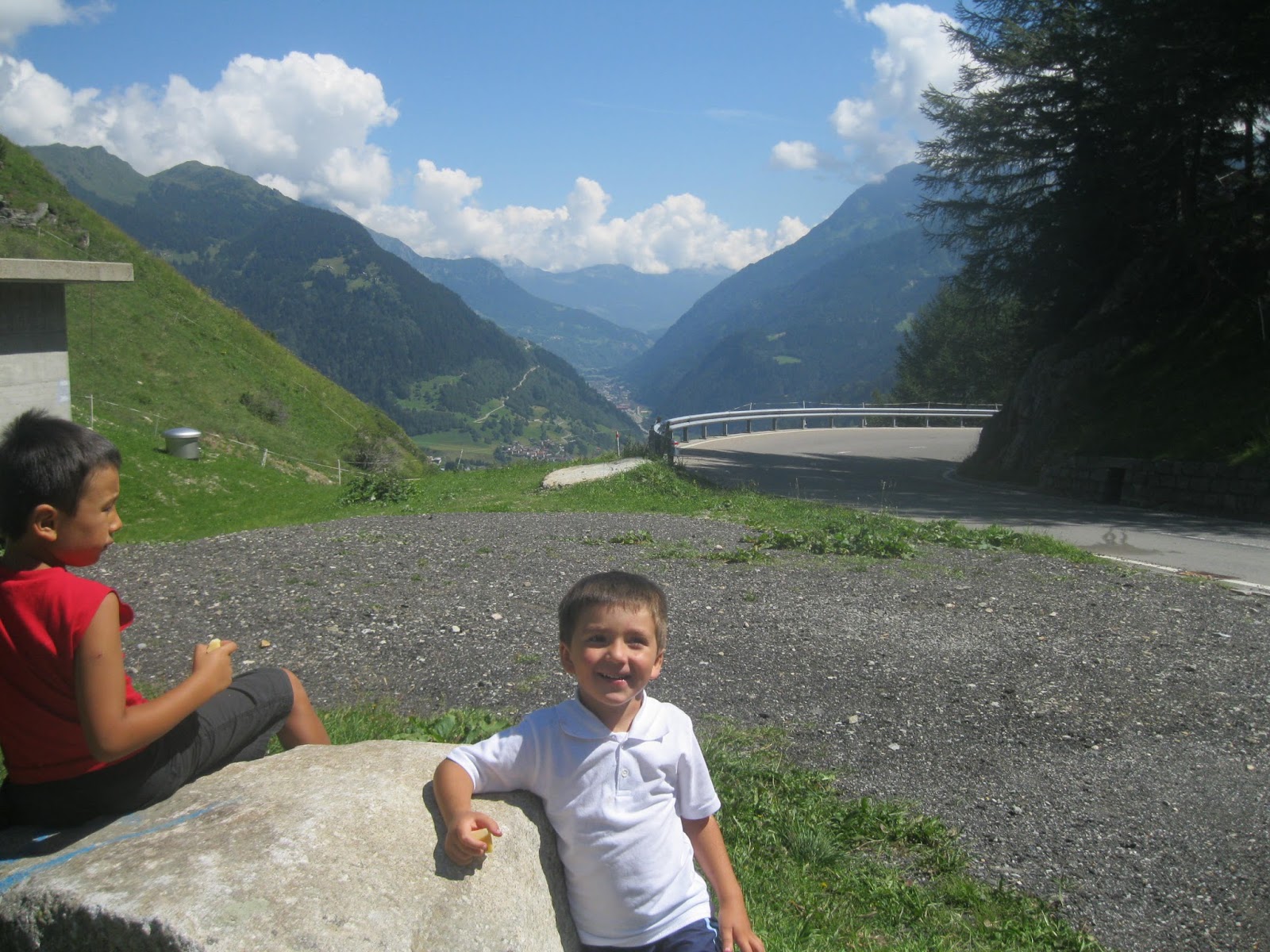
The children in the Alps.
Lunch Stop.
After we descended a few hundred meters, we saw cows!  We did not expect them this high up. While it was still windy and cool, the snow was gone and there was plenty of grass. However, the fence was not electric as it is typical here, and so there was a human  who seemed to be looking after the cows ... and a really cold and green looking lake. Edward and I put our toes in it to test the temperature. The water was very clean, and it had the color of the small trees, bushes and other vegetation around it.


We are now back to spiel-group, school and work!


Wednesday, June 26, 2013

How fast can neutron stars spin?

Image Credit: NASA (artist impression)
The fastest spinning stars in the universe are called millisecond pulsars because they rotate between 100 times and 1000 times a second!

These neutron stars are the best natural clocks in space and if we want to understand the universe it's only sensible to want to know what limits their rotation rate and what could be the most precise clock of this type.

The first millisecond pulsar was discovered in 1982, the year I was born in. I know.... I am getting old, but so is this discovery. This pulsar spins about 641 times every second and was able hold onto its speed record until 2006 when scientists discovered a faster pulsar that has a spin frequency of 716 Hz. By 2006 I was 24 and already getting close to finishing my Cornell PhD on the nonlinear development of the R-mode instability, a mechanism that provides a limiting spin frequency for neutron stars, which depends on their internal physics, and could explain why we see so few fast pulsars and why we have not seen any that spin much faster than 700 times a second. 

I work on other topics now, but the topic of my PhD thesis has remained close to my heart.  So, below I summarise my latest paper in collaboration with Prof. Ira Wasserman (one of my two PhD advisors) on R-modes. The paper is now published in the Astrophysical Journal and on the arXiv at http://arxiv.org/abs/1305.2335 .

Brief Summary
The conventional picture is that a sharp boundary layer forms causing high viscous dissipation. In this case, the R-mode instability prevents the spin-up of neutron stars to frequencies larger than about 300 Hz, where gravitational driving matches viscous dissipation due to boundary layer viscosity. The red line in the figure below shows the typical evolution of a neutron star in the frequency (Hz) - temperature (in units of 108 K) plane in the presence of boundary layer viscosity. Since we observe neutron stars than spin faster than 300 times a second, this picture cannot be correct or complete. 

We argue that boundary layer viscosity becomes negligible when  the transition between the fluid core to the crystalline crust happens over distances larger than 1 cm.  We find that the spin up from accretion torque is larger than the spin down due to emission of gravitational waves and that continued spin-up due to accretion from a companion allows frequencies of up to about 750 Hz. The blue line represents a neutron star trajectory in the frequency- temperature plan in the latter case.The maximum frequency would be lower (plausibly about 750 Hz) than in the figure for typical Copper pair cooling inside the neutron star core.

What are R-modes? What is the R-mode instability? How does it work?

When a sharp boundary layer forms.
The star continues to spin-up (low viscosity).
R-modes are stellar oscillations that exist in rotating neutron stars and are driven unstable by gravitational radiation emission. Fast spinning neutron stars remain R-mode unstable as long as the gravitational driving is larger than the viscous dissipation.

In the two figures, the viscous dissipation and gravitational driving are equal on black curve; above the said black curve the L=m=2 R-mode is unstable and below the curve the R-mode is stable and its amplitude damps exponentially to insignificant values.

 In the instability window, where the L=m=2 R-mode is unstable, gravitational radiation emission spins down the star. However, the star can continue to spin up if the spin-up torque caused by accretion from a companion is greater that the spin-down caused by gravitational radiation and by magnetic dipole radiation emission. This happens when when viscosity is very low. In this scenario, the L=m=2 oscillation mode saturates at low amplitude due to nonlinear coupling to near-resonant oscillations in the star. The R-mode saturation amplitude is proportional to the viscous dissipation of the pair of near-resonant modes that are first excited by the R-mode. The limiting spin frequency of the star depends on accretion physics, viscosity and neutrino cooling. In this paper we include the first analytic estimate of this frequency and of the saturation amplitude of the R-mode that includes nonlinear effects.

Potential Future work
1. It would be good to understand the temperature distribution of the neutron stars that could have active R-modes.  R-modes heat up the star. But is that observable? Do they heat it too much to be consistent with existent data or are the error bars so large that we cannot say much?

2. The distribution of couplings between the R-mode and other modes in the star is not known, and the approximations currently made are very rough. The couplings can be computed analytically for certain very specific models. They assume that the neutron is incompressible, which mean its density is assumed to be constant everywhere, and find very sparse couplings between modes. It would be interesting to see how the coupling distribution changes when the  incompressiblity constraint is relaxed. My guess is that the coupling distribution is more complex, and may be either sparse or dense depending on parameters.

Would R-modes affect the stability of the "neutron star clock"? how about glitches?
The R-modes I have considered are oscillations of the core of the star. Active R-modes heat the core of the star. However, connecting the surface temperature to the core temperature is not trivial. Oscillations in the frequency of the star due to R-modes are un-modelled on short timescales.

R-modes on Earth?
R-modes (known as Rossby waves) also exist in the oceans and the atmosphere of Earth and can cause changes in the weather pattern. However, such oscillations in the core of the star are proportional to the angular frequency of the star and are only significant for neutron stars rotating close to millisecond periods.

What are neutron stars and how to we observe them?
Neutron stars are the tiniest and densest stars in the universe. When a star that is about ten times as massive as our sun reaches the end of its life, it explodes violently ejecting its outer layers, but leaving the core. The left-over core then collapses under its own weight to a neutron star or a black hole. The neutron star will be about once or twice as massive as our sun, but packed into the diameter of an average city (about 10 to 20 km) and will spin very fast. Its density and temperature is far greater than anything achievable on Earth. Since these stars are so different from our own planet, our understanding of the physics of this ultra-dense matter is still poor.

Telescopes on Earth were the first to see pulsars, which are a rotating neutron stars that emit radio signals. This signal is spotted if it is beamed towards us. It appears to pulse because the star rotates. Jocelyn Bell Burnell identified the first pulsar in 1967. They were first thought to be signals from aliens in space and hence dubbed Little Green Men. A few years later they were identified as rapidly rotating neutron stars. Now we see neutron stars with many telescopes and observatories on Earth and in Space. Scientists time them accurately and try to infer their surface temperature when possible.

Observational windows opening in the future
Scientists use gravitational wave detectors on Earth  (e.g., LIGO, VIRGO) to search for gravitational waves emitted by single neutron stars either due unstable oscillations inside them or due to small mountains on their surface (continuous wave searches) and by binary neutron stars (compact binary searches). The binary neutron stars are particularly important gravitational wave sources because we know they exist and we know where some of them are.  We cannot yet say the same for the binary black hole sources, or the black hole-neutron star binaries.

Advanced LIGO will be taking data and hopefully discovering some of these sources in about two-three years from now. So far there are only null results to gravitational wave searches that put upper limits on existing physics. This is the LIGO outreach page that describes some of the most important publications written by the collaboration. 

Pulsar clocks
Isolated millisecond pulsars are really good clocks.  Potential applications of accurate pulsar timing include using pulsars to guide space craft navigation and gravitational wave detection in a different frequency band than ground based detectors.

I will conclude with a pulsar version of "twinkle-twinkle little star":

"Twinkle, twinkle little star
You must be a small pulsar
Far away from Earth you spin
You have high magnetic field
Twinkle, twinkle little star
Degenerate matter's what you are."

Note: This is a slightly modified version from SMBC comics.

Literature.  
  1.  R. Bondarescu, and I. Wasserman, “Nonlinear Development of the R-mode Instability and the Maximum Rotation Rate of Neutron Stars”, Astrophys. Journal 778, 9 (2013). [arXiv:1305.2335]. 

2. R. Bondarescu, S. A. Teukolsky, I. Wasserman, “Spinning Down Newborn Neutron Stars: Nonlinear Development of the R-mode Instability”, Phys. Rev. D 79, 104003 (2009).  [arXiv:0809.3448]. 

3. R. Bondarescu, S. A. Teukolsky, I. Wasserman,  “Spin Evolution of Accreting Neutron Stars: Nonlinear Development of the R-mode Instability”,  Phys. Rev. D 76, 064019(2007) [arXiv:0704.0799].  

Thursday, April 4, 2013

What is the End State of the Universe?

It is tantalizing to look at history and predict the future. People (and later scientists, i.e., people who dedicate their lives to answering questions) wanted to know "why life formed? why are we here?" almost from the beginning of mankind. The answer to these questions has never been fully understood. In our most recent paper [arXiv:1304.0594 - Title: "Merging Gravitation with Thermodynamics to Understand Cosmology"], Andrew Lundgren, Mihai (my brother) and I discuss why the universe evolved from a hot and uniform past to its cold, clumpy state where planets and stars and humans exist, what will be the final state of the universe, and how to compute the total entropy inside a star. It is believed that the evolution of the universe is dictated by the second law of thermodynamics, which states that entropy (the degree of disorder or the number of indistinguishable configurations of a system) always increases.

However, in general, a hot and uniform gas has higher entropy than a solid or liquid because in a gas particles can move around freely and the degree of disorder is higher. So, why did stars form? we are "clumpier" than gas and so why are we here? Well... because of gravity. Gravity has entropy too. As a gas collapses to a star and later forms a black hole, the entropy increases.

The largest repositories of entropy are gravitational: the cosmic microwave background, the cosmological horizon and the supermassive black holes.

 Brief History of the Universe:
How do we know the universe was uniform and hot early on? From the WMAP and more recently from the Planck satellite who mapped residual light from the Big Bang. The largest temperature difference seen by WMAP in this primordial light was 0.0004 K! Planck has provided an even more detailed map of temperature fluctuations that will lead to more realistic models of the beginning of the universe.

The Clumpy Universe.
As the universe expanded, it became colder and clumpier, and more and more structure formed. Radiation and later matter dominated the early universe. In time, the concentration of matter and radiation decreased, and then dark energy, which causes the accelerated expansion observed today, started to dominate the universe. Leading theories propose dark energy is either a constant energy density or a scalar field (quintessence) that mimics the cosmological constant, but can vary in space and decays away in time. 


The Frozen Far Future.

The future of our local supercluster
  Over the next 1012 years most matter will stream beyond the cosmological horizon, leaving dark energy to completely dominate the large scale of the universe on scales above 100 Mpc. However, the local supercluster is decoupled from the expansion of the universe, and will remain gravitationally bound. Everything in the local universe will coalesce into supermassive black holes that slowly evaporate or be ejected (Adams and Laughlin 1997)


The far future of the Universe.
Schematic BH Evaporation. Cosmological horizon = blue.
The cosmological horizon is colder than anything else in the universe. Since heat flows from hot to cold, the horizon is slowly absorbing the contents of the universe producing entropy and grows in response. In time, all that will be left is supermassive black holes that slowly evaporate transferring more heat over the horizon and producing entropy. The emptying of universe is an approach to equilibrium.

The end state of the universe?
The equilibrium state of a system is its most generic state. The equilibrium state of gas in a box is one where the gas is uniformly distributed. Flat Minkowski space and deSitter space (the space with a cosmological constant) are both maximally symmetric. This means that they have a full set of ten symmetries: three rotations, three boosts, one time and three space translations. However, deSitter has a cosmological constant, which restricts the wavelength of gravitational waves, which are modes of the Weyl tensor (a mathematical quantity that measures the curvature of spacetime). When the cosmological horizon grows, the number of accessible microstates in the Weyl tensor increase leading to an increase in the total entropy of the universe.

 Mathematically, one recovers flat space from deSitter space in the limit in which the cosmological constant is zero. In that case the temperature of flat space is zero and its entropy is divergent. This divergence is first mentioned by Curir and Demianski in 1979, and then later mentioned in passing in other papers. This finding has been largely ignored and there is no discussion in the literature of its potential impact.

Since flat space has higher entropy than deSitter, the second law of thermodynamics favors a decay from deSitter to flat space, which could happen if deSitter is unstable when quantum effects are considered or if the cosmological constant is mimicked by a scalar field that slow rolls to flat space.

 Gravitational Entropy.
 I hope have convinced you that gravitational entropy is important in the evolution of the universe. But how do we compute it? It's difficult to define gravitational entropy in the absence of a horizon (otherwise, one can use the Bekenstein-Hawking formula - the entropy of a black hole is a quarter the area of its horizon; this formula applies to the cosmological horizon and to other horizons as well). Gravitational thermodynamics is challenging because gravity is non-local. Energy cannot be defined at a point in general relativity because of the equivalence principle. Switching to a free falling elevator removes all local gravitational effects. So, scientists define quasi-local quantities, which are hard to compute for general situations because they involve surface integrals and it is also not clear which formalism to use. We use the Brown-York quasi-local energy, which counts the total energy inside the surface, and write the first law of thermodynamics in terms of quasi-local quantities to compute the total entropy inside a star.  The result is fairly simple. The entropy of the star is not constant inside and it is smaller than the entropy outside the star.